

When a US AI team decides to outsource data labeling, the real decision is rarely “should we outsource?” — it is “offshore or nearshore?” The two models pull in opposite directions. Offshore wins on the sticker price. Nearshore wins on speed, communication, and control. Choose wrong and you either overpay for proximity you did not need or, more commonly, discover that a rock-bottom hourly rate came bundled with delays and rework that erased the savings. This comparison lays out the trade-off honestly, across the four factors that actually decide project outcomes: cost, quality, speed, and security.
Offshore vs Nearshore: The Core Difference
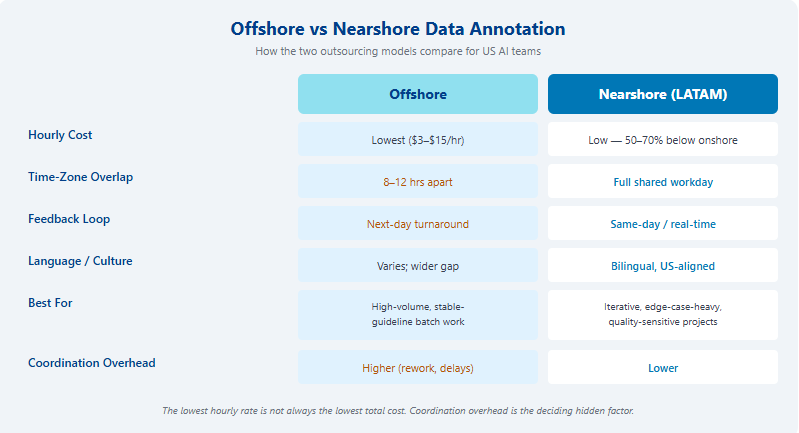
Offshore data annotation sends your labeling work to distant, low-wage markets — India, the Philippines, parts of Eastern Europe and Africa — typically 8 to 12 time zones away from the United States. Nearshore data annotation keeps the work in nearby countries that share US business hours; for American companies, that means Latin America. Both are cheaper than labeling onshore in the US. The question is which trade-off fits your project, because the two models are strong in different places and the right choice depends entirely on what your annotation work actually demands.
Cost: Sticker Price vs Total Cost of Engagement
On raw hourly rate, offshore wins clearly. Offshore annotation typically runs in the range of a few dollars to around fifteen dollars per hour depending on country and complexity — often 40 to 70 percent below onshore equivalents. Nearshore LATAM rates land higher than the cheapest offshore markets but still deliver roughly 50 to 70 percent savings against US onshore labeling. But hourly rate is only part of the equation, and treating it as the whole is the most common costing mistake teams make. The metric that matters is total cost of engagement — the sticker price plus the hidden costs of coordination, rework, and delay. When a labeling team is half a day out of sync, a single misunderstood guideline can mean a full batch labeled incorrectly before anyone catches it, then a full day lost to the correction cycle. Multiply that across an iterative project and offshore’s headline savings can quietly evaporate. Nearshore’s slightly higher rate frequently produces a lower total cost precisely because those coordination losses shrink.Quality: Where Feedback Speed Meets Accuracy
Annotation quality is not just a function of how skilled the annotators are — it is a function of how quickly guideline ambiguity gets resolved. Every dataset hits edge cases the original instructions did not anticipate. The question is how fast those get clarified. In a nearshore model with a shared workday, an annotator flags the ambiguity and gets an answer the same afternoon, before the misunderstanding spreads across thousands of labels. In an offshore model, the question waits for the next overlap window, and in the meantime the team either guesses or stalls. Cultural and language alignment compounds this. Guidelines written by a US team are interpreted most faithfully by annotators who share the cultural context those guidelines assume. A wider cultural gap introduces systematic, repeatable misreadings — not random errors, but consistent ones that are harder to detect and more damaging to model training. This is why nearshore tends to produce more consistent ground truth on nuanced tasks, while offshore can match it on well-defined, unambiguous, high-volume labeling where interpretation plays a smaller role.Speed: Iteration Velocity Is the Real Differentiator
Modern AI development runs on tight retraining loops. A model reveals a weakness, you need targeted new labels, you retrain, you evaluate, you repeat. The velocity of that loop is often the difference between shipping on schedule and slipping. Nearshore’s real-time collaboration collapses the annotation portion of each cycle from days to hours. Offshore’s time gap builds a structural delay into every iteration — not because the team is slower, but because the working hours simply do not overlap enough for fast exchange. For a one-time, fixed labeling batch, this barely matters; you send the spec, you wait, you receive the data. For continuous, evolving annotation programs — which describe most production AI work today — iteration velocity becomes the dominant factor, and it favors nearshore decisively.Security and Compliance
Both models can be secure, but proximity simplifies oversight. Nearshore providers serving US clients typically operate under SOC 2, ISO 27001, HIPAA, and PCI DSS frameworks, and their geographic and legal closeness makes audits, secure data-handling agreements, and regulatory alignment more straightforward. Offshore providers can hold the same certifications, but managing compliance across distant jurisdictions with different data-protection regimes adds complexity — and some projects involving sensitive financial, health, or government data carry restrictions on where data may physically be processed, which can rule out certain offshore locations entirely.Which Should You Choose? A Simple Decision Framework
The honest answer is that it depends on your project’s profile, and the choice is usually clear once you name that profile. Choose offshore when your work is high-volume, low-complexity, and governed by stable guidelines that will not change — straightforward image tagging or basic categorization at massive scale, where the lowest rate genuinely translates to the lowest total cost. Choose nearshore when your work is iterative, edge-case-sensitive, domain-specialized, or bilingual — when guideline clarity and fast feedback determine quality, and when the coordination overhead of a distant team would erode the savings. For the majority of US teams building and continuously improving production models, that second profile is the common one, which is why nearshore has been gaining ground. SkyCom’s data annotation services deliver the nearshore model across five Latin American countries — bilingual annotation teams on US business hours, multi-level quality control, and full compliance coverage — so US AI teams get the cost savings of outsourcing without the delay and rework that make offshore expensive in ways the invoice never shows.Conclusion
Offshore versus nearshore is not a question of which model is universally better — it is a question of which trade-off matches your annotation work. Offshore delivers the lowest hourly rate and suits stable, high-volume batch labeling. Nearshore delivers time-zone alignment, faster iteration, tighter quality control, and simpler compliance, and it suits the iterative, quality-sensitive, and bilingual projects that make up most modern AI development. The mistake to avoid is choosing on hourly rate alone, without accounting for the coordination costs that determine total cost of engagement. If your project favors speed, consistency, and real-time collaboration, SkyCom’s nearshore data annotation team can help you scale accurate training data on your schedule. To go deeper on the nearshore model specifically, see our companion guide on why US AI teams are moving annotation closer to home.High-quality training data increasingly depends on nearshore data annotation.
Computer vision projects hinge on image annotation for computer vision.