

Every computer vision model that recognizes a tumor on a CT scan, stops a self-driving car at a pedestrian, or flags a defective part on an assembly line learned to do so from one thing: labeled images. A model does not see a “car” or a “melanoma.” It sees a grid of pixels, and it only learns what those pixels mean because a human first drew a box, traced an outline, or marked a point and attached a label to it. That labeling process is image annotation, and it is the single most decisive factor in whether a computer vision system works in the real world or fails silently in production.
Here is the uncomfortable truth most teams discover too late: a state-of-the-art model architecture trained on mediocre annotations will lose to an average architecture trained on excellent ones. Research teams consistently report that a first pass on a fresh dataset lands somewhere around 70% accuracy, and the path from there to production-grade performance runs almost entirely through better, more consistent labeled data — not through a bigger neural network. Image annotation for computer vision is where model quality is actually won or lost.
This guide covers what image annotation is, the core annotation types and when to use each, the file formats that determine whether your labels are usable, real-world applications across industries, the modern 2026 workflow that blends automation with human review, and the best practices that separate reliable training data from expensive relabeling. Whether you are scoping your first annotation project or trying to fix a stalled one, you will leave knowing exactly what “good” looks like.
What Is Image Annotation in Computer Vision?
Image annotation is the process of attaching human-readable labels to visual data so that a machine learning model can learn to recognize, classify, and locate objects within images. In practical terms, an annotator adds structured metadata — a bounding box, a segmentation mask, a keypoint, a class tag — to raw pixels, producing the “ground truth” that a supervised learning model trains against.
The concept is old. An MIT professor famously assigned image recognition to a group of undergraduates as a single summer project in 1966, assuming a camera and a computer could be taught to describe what they saw in a few months. That “summer” turned into six decades of research, and the breakthrough that finally made computer vision reliable was not just better algorithms — it was the arrival of large, accurately labeled datasets that models could learn from.
The distinction that matters most: annotation is not “drawing boxes.” It is the disciplined creation of consistent ground truth, governed by clear guidelines, measured quality, and traceable outputs. Two annotators labeling the same image should produce nearly identical results. When they do not, the model inherits that disagreement as noise, and no amount of training compute will fully correct for it. This is why professional data annotation services treat guideline design and quality control as first-class deliverables, not afterthoughts.
Why Image Annotation Determines Model Accuracy
Supervised computer vision models learn by example. During training, the model makes a prediction, compares it against the annotated ground truth, measures the error, and adjusts its internal weights to reduce that error. Repeat this across millions of examples and the model gradually learns the visual patterns that define each class. Every step of that loop depends on the annotation being correct. If the ground truth is wrong, the model is being taught to be wrong — confidently and at scale. The failure mode is insidious because it is invisible. A mislabeled dataset does not throw an error. It simply produces a model that underperforms for reasons that are hard to diagnose, because the problem is buried in the training data rather than in the code. Teams often spend weeks tuning hyperparameters and swapping architectures when the real fix was correcting a few thousand inconsistent labels. Three annotation quality dimensions map directly to model outcomes.
Accuracy — whether each label correctly identifies and locates its object — sets the ceiling on model precision.
Consistency — whether the same object is labeled the same way across the entire dataset — determines whether the model learns a stable pattern or a noisy one.
Completeness — whether every relevant object in every image is labeled — prevents the model from learning to ignore objects that annotators missed.
Weakness in any one of these three propagates straight into production performance.
The 6 Core Types of Image Annotation
Different computer vision tasks require different annotation geometries. Choosing the right type is a trade-off between precision, cost, and the demands of your specific application. Over-annotating wastes budget; under-annotating starves the model of the detail it needs. Here are the six techniques that cover the vast majority of production projects.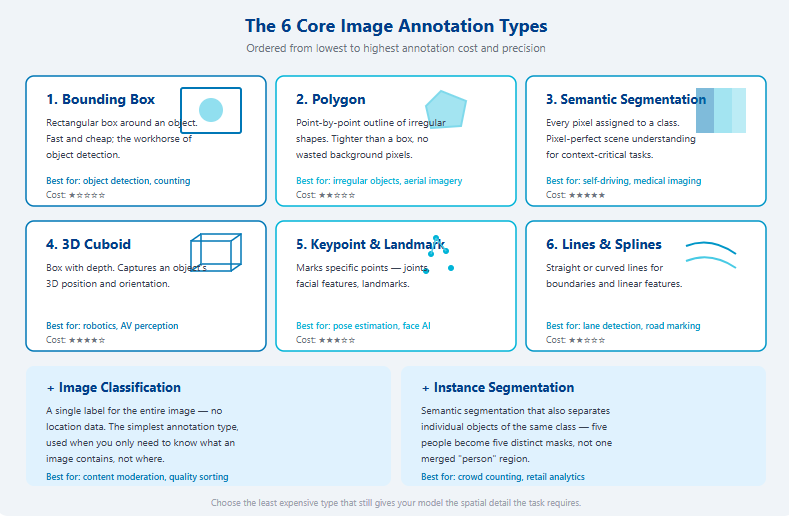
Bounding Boxes
The bounding box is the most widely used annotation shape in computer vision. Annotators draw a rectangle around each object of interest, capturing its class and approximate location. Boxes are fast to create, cheap to scale, and sufficient for most object detection tasks — identifying and counting vehicles, people, products, or animals. Their limitation is precision: a rectangle around an angled or irregular object inevitably includes background pixels, which can confuse models that need tight object boundaries.
Polygons
Polygon annotation traces an object’s actual contour using a series of connected points, producing a far tighter outline than a rectangle. This matters for irregularly shaped objects — buildings in satellite imagery, produce, anatomical structures, or any object where surrounding background pixels would degrade model learning. Polygons cost more per object because they require more clicks and judgment, but they deliver the accuracy that box annotation cannot.
Semantic Segmentation
Semantic segmentation is pixel-level annotation: every single pixel in the image is assigned to a class — road, sidewalk, pedestrian, sky, building. The result is a complete, pixel-perfect map of the scene. This is the most labor-intensive and expensive annotation type, and it is essential wherever full environmental context matters, such as autonomous driving and medical imaging. Benchmark datasets like Cityscapes, which provides pixel-level annotations across thousands of urban street scenes, set the standard for what segmentation quality looks like in the self-driving domain. The model does not just know an object is present; it knows the exact shape and extent of everything in the frame.
3D Cuboids
A 3D cuboid extends the bounding box concept into three dimensions, adding depth so the annotation captures an object’s real-world position, orientation, and volume. This is critical for applications that must reason about physical space — a robot judging how far away an obstacle is, or an autonomous vehicle estimating whether a car in the next lane is angled toward it. Cuboid annotation often pairs with LiDAR and sensor-fusion data for perception systems.
Keypoint and Landmark Annotation
Keypoint annotation marks specific points of interest on an object — the joints of a human body for pose estimation, the corners of the eyes and mouth for facial recognition, or defined landmarks on a product. By connecting these points, models learn to understand structure and movement. Landmarking is foundational to face recognition, gesture control, sports analytics, and any application that tracks how a body or object is positioned.
Lines and Splines
Line and spline annotation marks linear features using straight or curved paths. The canonical use case is autonomous driving, where annotators trace lane markings, road edges, curbs, and sidewalks so a self-driving system can understand drivable boundaries. Because these features are linear rather than area-based, lines are more efficient to annotate than full segmentation while still capturing the boundary information the model needs.
Image Annotation Formats: COCO, YOLO, and Pascal VOC
Choosing the right annotation type is only half the decision. The format your annotations are stored in determines whether your labeled data can actually be loaded by your training framework. A format mismatch is one of the most common and costly mistakes in computer vision projects, precisely because it fails silently. Coordinates interpreted in the wrong system, class IDs that do not align, or a single-file structure passed to a framework expecting one file per image will all train a model on corrupted data without producing a single error message.
Three formats dominate production pipelines in 2026. Each stores the same fundamental information — object class and location — but encodes it differently.
COCO (JSON). The Common Objects in Context (COCO) format stores an entire dataset in a single structured JSON file containing image metadata, category definitions, and rich annotations including bounding boxes, segmentation polygons, and keypoints. COCO is the standard for research frameworks and any project needing complex, multi-type annotations in one dataset-level structure. Choose COCO when your project spans detection, instance segmentation, keypoints, or attributes and you want a single source of truth across multiple experiments.
YOLO (TXT). The YOLO format creates one lightweight text file per image, with each line encoding an object’s class ID and normalized center-x, center-y, width, and height. Because YOLO models — carried forward consistently through YOLOv5, YOLOv8, YOLO11, and beyond — dominate real-time object detection in 2026, the YOLO TXT format has become the practical standard for any pipeline where inference speed is the priority. It is minimal, fast to parse, and directly compatible with modern detection training.
Pascal VOC (XML). Pascal VOC, the visual object classes benchmark maintained by the University of Oxford, stores one human-readable XML file per image with absolute pixel coordinates. It is verbose and easy for a person to inspect, which makes it useful for annotation review and quality assurance, but it is not natively consumed by most modern detection models. In current pipelines, VOC functions mainly as an interchange and inspection format that gets converted to a training-ready format before use.
The practical rule: use COCO when you need rich, multi-type annotations; use YOLO when you need fast object detection and direct compatibility with modern pipelines; use Pascal VOC for inspection, QA, or legacy tooling. And treat every format conversion as a quality-control checkpoint — a careless COCO-to-YOLO conversion that mishandles category IDs or coordinate normalization introduces hidden label noise that quietly degrades model performance in production.
Real-World Use Cases of Image Annotation for Computer Vision
Image annotation is not an academic exercise. It is the foundation beneath computer vision systems generating measurable value across every major industry. The annotation type and quality standard shift with the stakes of the application.
Healthcare and Medical Imaging
AI-powered diagnostic tools depend on precisely annotated medical datasets. Radiologists and trained annotators label organs, tissues, tumors, and abnormalities across CT scans, MRI images, and X-rays, teaching models to detect disease, assist diagnosis, and support treatment planning. Research published in the National Library of Medicine underscores how directly annotation quality affects diagnostic model reliability, with noisy labels shown to meaningfully degrade segmentation performance in clinical settings. Here, annotation precision is not a cost optimization — it is a patient-safety requirement, which is why medical annotation demands domain expertise and rigorous, compliant quality control. These same standards underpin healthcare AI operations where labeled data drives clinical decision support.
Autonomous Vehicles and Mobility
Self-driving systems consume enormous volumes of annotated data — bounding boxes and cuboids around vehicles and pedestrians, semantic segmentation of entire street scenes, and line annotation of lane markings and road edges. Because an autonomous vehicle must handle rare, dangerous edge cases correctly, annotation for this domain emphasizes scenario diversity and near-perfect consistency across millions of frames.
Retail and E-Commerce
Computer vision powers visual search, automated product categorization, shelf monitoring, and recommendation engines. Annotators label product images with bounding boxes and attribute tags so models can identify items, read shelves, and match a shopper’s photo to a catalog entry. Instance segmentation supports inventory analytics by counting and distinguishing individual products.
Manufacturing and Quality Control
On production lines, computer vision inspects parts for defects at speeds no human team could match. Annotators label defective and non-defective components — often with polygons or segmentation to capture subtle flaws — training models to flag cracks, misalignments, and surface defects automatically. The payoff is faster inspection with fewer defects reaching customers.
Security and Smart Surveillance
Intelligent surveillance systems rely on annotated video and image data for object detection, facial landmark recognition, activity classification, and event detection. Annotation teams label people, vehicles, and behaviors so systems can distinguish routine activity from events that warrant an alert.
The Modern Image Annotation Workflow in 2026
The way high-performing teams annotate images has changed. The old debate — manual labeling versus fully automated labeling — is settled. Neither wins alone. Manual annotation is accurate but scales poorly and grows expensive fast. Fully automated labeling is fast but unreliable on the long-tail, unusual cases that determine real-world robustness. The winning approach in 2026 is a human-in-the-loop pipeline that combines both.
Here is how a modern workflow runs. First, model-assisted pre-labeling generates a rough first pass — auto-generated boxes and masks, increasingly powered by promptable segmentation models in the Segment Anything (SAM) family from Meta AI that can produce a mask from a single click. This removes the tedious bulk of the work. Second, human annotators verify, correct, and handle the edge cases the automation gets wrong — the occluded object, the ambiguous boundary, the rare class the model has never seen. Third, an active learning loop prioritizes which unlabeled images are most valuable to annotate next, focusing expensive human effort on the samples that will most improve the model rather than labeling everything indiscriminately.
This blended model captures the best of both worlds: automation handles volume, humans handle judgment and quality. But it only works when the human layer is genuinely skilled and consistently managed. Promptable models accelerate mask creation, yet strong quality assurance remains mandatory for long-tail classes and domain shift — the situations where automated labeling is least reliable and most likely to inject silent errors. The human review layer is not a legacy cost to be automated away; it is the control system that keeps automated labeling honest.
Image Annotation Best Practices
The difference between annotation that produces a reliable model and annotation that produces expensive relabeling comes down to disciplined process. These practices consistently separate high-performing computer vision projects from stalled ones.
Write a detailed annotation guideline before labeling a single image: The guideline is the constitution of your dataset. It defines every class precisely, specifies how to handle occlusion, truncation, and ambiguous cases, and includes visual examples of correct and incorrect labels. Most annotation quality problems trace back to a vague or missing guideline. Invest here first.
Define your class schema carefully and lock it early: Adding or redefining classes midway through a project can silently invalidate everything labeled before the change. Decide what you are labeling, at what granularity, and with what attributes before annotation begins at scale.
Measure inter-annotator agreement: Have multiple annotators label the same subset of images and measure how often they agree. Low agreement is an early warning that your guidelines are ambiguous or your classes are poorly defined — catch it before it contaminates the full dataset. High agreement is the strongest signal that your ground truth is trustworthy.
Build multi-level quality control into the pipeline: Every professional annotation operation runs labeled data through structured review — annotator, peer review, automated validation checks, and expert audit. Single-pass annotation without review is how label noise reaches production. Layered QA is how you keep it out.
Prioritize consistency over speed: A slightly slower workflow that produces uniform labels across the entire dataset beats a fast one that produces inconsistent labels the model cannot learn from. Consistency is the quality dimension that most directly determines whether a model learns a stable pattern.
Match the workforce to the domain: Medical imaging, satellite data, and other specialized domains require annotators with subject-matter understanding. Generic labeling produces generic errors in specialized data. The workforce decision is one of the most important success factors in any computer vision project — which is why many teams partner with a dedicated annotation provider rather than assembling ad hoc teams. If you are weighing that choice, our guide on evaluating annotation partners covers the criteria that matter most.
How SkyCom Delivers Image Annotation for Computer Vision
Building accurate computer vision training data at scale requires three things working together: a skilled human workforce, disciplined quality processes, and the ability to scale without sacrificing consistency. SkyCom’s data annotation services combine dedicated in-house annotation specialists with AI-assisted validation and multi-level quality control across every major annotation type — bounding boxes, polygons, semantic and instance segmentation, 3D cuboids, keypoints, and lines.
SkyCom’s nearshore LATAM delivery model adds a specific advantage for computer vision teams: time-zone alignment with the United States enables real-time oversight of annotation quality rather than the overnight lag typical of offshore operations. That proximity matters most exactly where annotation is hardest — resolving edge cases, refining guidelines mid-project, and keeping a human-in-the-loop workflow tightly managed. Combined with rigorous quality assurance and the flexibility to scale from thousands to millions of annotations, it lets AI and machine learning teams move from raw images to production-ready training data with confidence.
Conclusion: Accurate AI Starts with Accurate Annotation
Image annotation for computer vision is not a preliminary chore to rush through on the way to model training. It is the phase where model quality is actually decided. The teams that build reliable computer vision systems are the ones that treat annotation as a discipline: they choose the right annotation type for the task, store labels in the correct format, write precise guidelines, measure inter-annotator agreement, and run every image through layered quality control.
The technology around annotation keeps advancing — promptable segmentation models and active learning loops make skilled annotators dramatically more productive than they were even two years ago. But the fundamental equation has not changed. A model is only as good as the data it learns from, and that data is only as good as the annotation behind it. Get the annotation right, and everything downstream gets easier. Get it wrong, and no architecture will save you.
If you are ready to build computer vision training data that holds up in production, SkyCom’s data annotation experts can help you scale accurate, human-verified image annotation across any format and use case. High-quality training data increasingly depends on nearshore data annotation. Choosing a delivery model matters just as much, as we compare offshore vs nearshore data annotation.