For years the outsourcing choice looked binary. Keep work onshore and pay for it, or send it offshore and accept the gaps: overnight handoffs, accents customers struggle with, and supervisors who are asleep when problems happen.
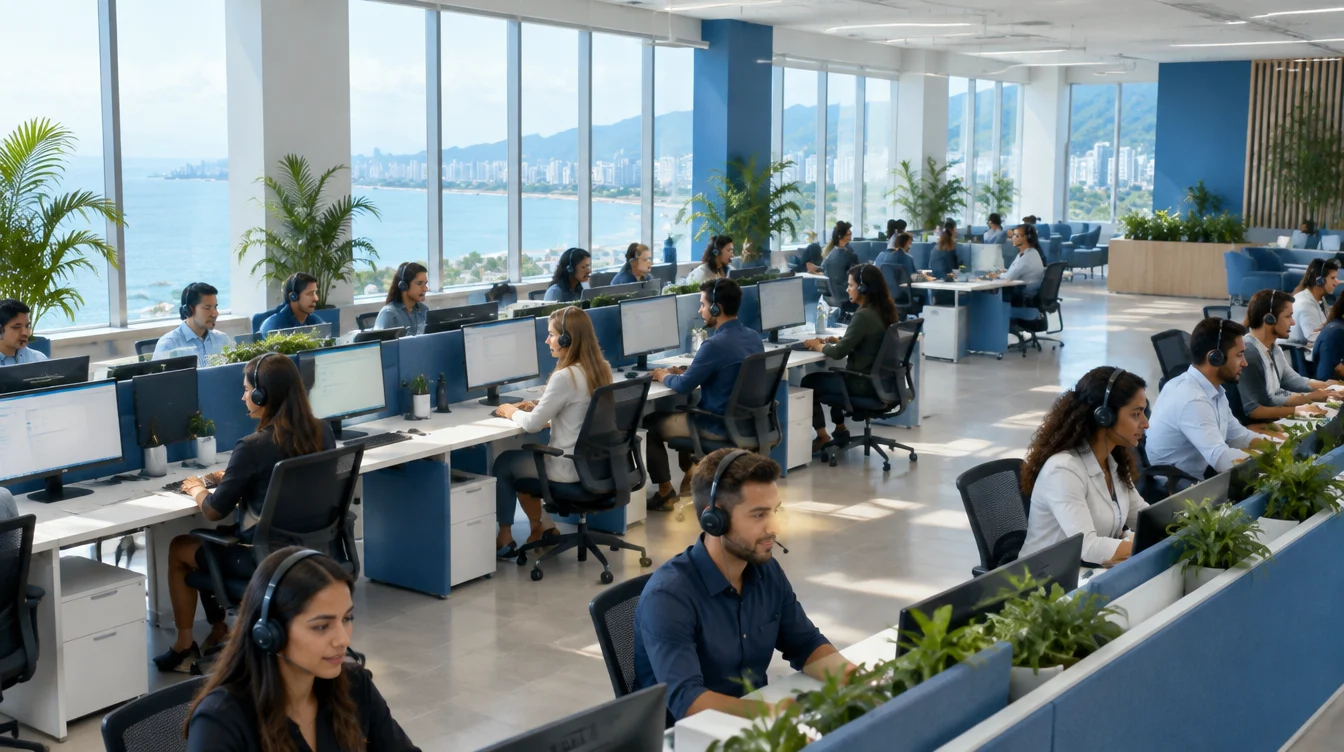
Latin America closes most of that gap. Agents work your hours, share many of your customers’ cultural references, and switch between English and Spanish in the same call. Managers can call a team lead at 2 p.m. New York time and get an answer, or be on the floor after a short flight. That is why nearshore has become the default for U.S. brands that care about CSAT as much as cost.
50-70%
lower cost than U.S. onshore teams, with real-time overlap on your business day
Side by side
Nearshore vs onshore vs offshore
How the three delivery models compare on the factors that shape customer experience.
Factor
LATAM nearshore (SkyCom)
Onshore (U.S.)
Offshore
Cost
LATAM nearshore (SkyCom)
50-70% lower than onshore
Onshore (U.S.)
Highest cost
Offshore
60-80% lower than onshore
Time-zone alignment
LATAM nearshore (SkyCom)
Real-time overlap, same-day collaboration
Onshore (U.S.)
Full overlap
Offshore
8-14 hour gaps
Language and culture
LATAM nearshore (SkyCom)
Native bilingual English and Spanish, strong U.S. affinity
Onshore (U.S.)
Native
Offshore
Lower affinity, variable accents
CSAT impact
LATAM nearshore (SkyCom)
High, from natural and empathetic conversations
Onshore (U.S.)
Highest
Offshore
Often lower from communication gaps
Agent quality and retention
LATAM nearshore (SkyCom)
Low turnover, rigorous training
Onshore (U.S.)
High quality
Offshore
Higher turnover, variable training
Oversight
LATAM nearshore (SkyCom)
Short, affordable flights for visits
Onshore (U.S.)
No travel needed
Offshore
Long, expensive travel
Scale and stability
LATAM nearshore (SkyCom)
Fast ramp-up, redundant sites
Onshore (U.S.)
Limited by labor cost
Offshore
Varies by location
Working hours
Your business day is their business day
Time zone in New York and at each SkyCom delivery location. All four sit within three hours of every continental U.S. zone.
New York
ET
San Salvador
UTC-6
Medellin
UTC-5
Kingston
UTC-5
Belize City
UTC-6
Our LATAM locations
Four countries, four different strengths
Most clients start in one location and add a second for coverage, language mix or business continuity.
Nearshore outsourcing means placing work with a partner in a nearby country that shares or nearly shares your time zone. For U.S. companies that usually means Mexico, Central America, Colombia or the Caribbean, where teams work U.S. hours and speak English and Spanish.
How much can nearshore outsourcing save compared with onshore?
SkyCom clients typically save 50-70% against U.S.-based providers. Programs of 5+ seats carry no setup, training or overhead fees, so the savings show up from the first invoice.
Is nearshore more expensive than offshore?
On hourly rates, offshore is often cheaper. On total cost, the gap narrows once you count repeat contacts, longer handle times, overnight management and travel. Many brands find nearshore delivers better CSAT for a modest difference in rate.
Which LATAM country is best for a call center?
It depends on the program. El Salvador suits large bilingual voice programs, Colombia suits digital channels and tech support, and Jamaica and Belize suit English-only voice, sales and retention. Many clients combine two.
Will customers notice an accent?
Agents are screened for native or near-native English and neutral accents, and they pass accent and comprehension certification before going live. Jamaica and Belize add native English-speaking teams.
Get started
Put a nearshore team on your next queue
Start with one queue, one location and five seats. A solutions lead replies within one business day with a model you can take to finance.