
American beauty has never been bigger, or more competitive. Globally, the beauty market reached about $441 billion in 2024 and is projected to grow around 5% a year through 2030, according to McKinsey’s State of Fashion: Beauty. The United States is one of the world’s largest beauty markets within that total. Yet the most interesting story is not size. It is the reshuffle. Legacy conglomerates still lead on revenue, while nimble challengers now own culture, search, and social. This guide ranks the top beauty and cosmetics brands in the U.S. for 2026 — and, importantly, shows exactly how we ranked them.
One theme runs through the whole retail and e-commerce beauty landscape: skincare leads. Skincare is the largest category by share of the global beauty market, and clinical, ingredient-led brands are capturing much of the growth. Meanwhile, celebrity and indie labels increasingly set the trends. Below, we start with the methodology, then the full ranking table, then detailed profiles.
How We Ranked the Top Beauty Brands
This ranking evaluates individual consumer-facing brands, not parent companies. That distinction matters, because many brands sit inside conglomerates that do not disclose brand-level revenue. So instead of a single revenue figure, we scored each brand across six weighted factors. The result is an editorial composite, designed to be transparent and explainable rather than a claim of audited precision.
| Ranking factor | Weight | What it measures |
|---|---|---|
| U.S. market presence | 25% | Retail and DTC footprint across U.S. channels |
| Brand scale indicators | 20% | Estimated size, distribution, and category weight |
| Consumer relevance | 20% | Recognition, loyalty, and everyday demand |
| Digital & e-commerce strength | 15% | Search, social, and online sales momentum |
| Product innovation | 10% | Formulation and category leadership |
| Brand momentum | 10% | Recent growth trajectory and cultural pull |
Scores are an editorial composite (out of 100) built from public reporting and industry trackers, not from audited brand-level financials. See Sources & Methodology below.
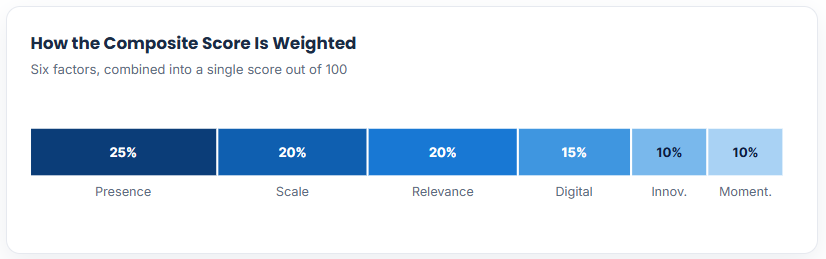
Each factor was scored from 0 to 100 using available public market, distribution, consumer, digital, innovation, and growth indicators. We then combined the weighted factors into a single composite score. To make the logic auditable, the table below shows the underlying factor scores for the top five brands, which weight-average to their published composite.
| Brand | Presence 25% | Scale 20% | Relevance 20% | Digital 15% | Innov. 10% | Moment. 10% | Composite |
|---|---|---|---|---|---|---|---|
| CeraVe | 96 | 90 | 95 | 90 | 92 | 92 | 93 |
| e.l.f. Cosmetics | 90 | 86 | 91 | 99 | 95 | 97 | 92 |
| Estée Lauder | 93 | 96 | 91 | 83 | 88 | 82 | 90 |
| Maybelline | 94 | 92 | 90 | 82 | 80 | 82 | 88 |
| L’Oréal Paris | 92 | 92 | 88 | 84 | 84 | 82 | 88 |
Illustrative factor scores for the top five brands. Factor scores are editorial judgments; the composite is their weighted average (25/20/20/15/10/10).
The Top 25 Beauty and Cosmetics Brands in the U.S.
| # | Brand | Category | Owner | Primary strength | Score |
|---|---|---|---|---|---|
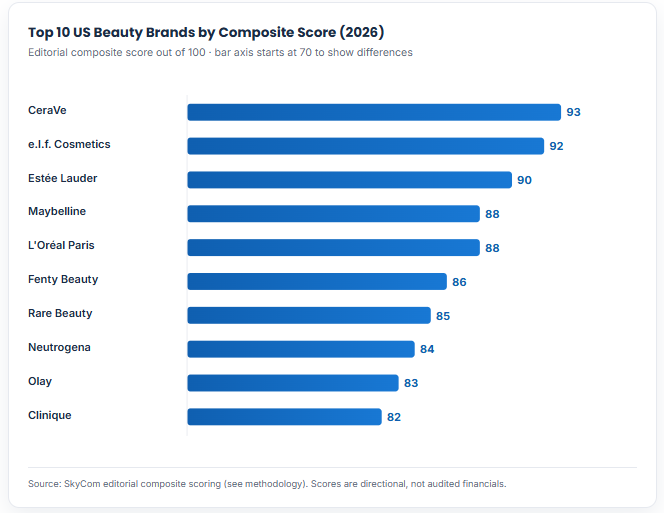
| 1 | CeraVe | Skincare | L’Oréal | Dermatologist-led credibility | 93 |
| 2 | e.l.f. Cosmetics | Makeup & skincare | e.l.f. Beauty | Value + digital | 92 |
| 3 | Estée Lauder | Prestige beauty | Estée Lauder Cos. | Luxury heritage | 90 |
| 4 | Maybelline New York | Mass makeup | L’Oréal | Mass-market scale | 88 |
| 5 | L’Oréal Paris | Mass beauty | L’Oréal | Breadth + reach | 88 |
| 6 | Fenty Beauty | Makeup | Kendo / LVMH | Inclusivity + culture | 86 |
| 7 | Rare Beauty | Makeup | Independent | Mission + virality | 85 |
| 8 | Neutrogena | Mass skincare | Kenvue | Trust + sun care | 84 |
| 9 | Olay | Skincare | Procter & Gamble | Anti-aging mass appeal | 83 |
| 10 | Clinique | Prestige skincare | Estée Lauder Cos. | Derm-guided prestige | 82 |
| 11 | MAC Cosmetics | Pro makeup | Estée Lauder Cos. | Artist credibility | 81 |
| 12 | The Ordinary | Skincare | Deciem (EL) | Ingredient-led value | 80 |
| 13 | Charlotte Tilbury | Prestige makeup | Puig | Hero products + digital | 80 |
| 14 | NYX Professional Makeup | Makeup | L’Oréal | Affordable pro appeal | 79 |
| 15 | Rhode | Skincare | e.l.f. Beauty | Minimalist momentum | 79 |
| 16 | Sol de Janeiro | Body & fragrance | L’Occitane | Viral body care | 78 |
| 17 | Glossier | DTC beauty | Independent | Community + brand | 77 |
| 18 | Kylie Cosmetics | Makeup | Coty (majority) | Celebrity reach | 76 |
| 19 | Glow Recipe | Skincare | Independent | Fruit-forward K-beauty | 76 |
| 20 | Drunk Elephant | Skincare | Shiseido | Clean-clinical niche | 75 |
| 21 | Tatcha | Luxury skincare | Unilever | J-beauty ritual | 75 |
| 22 | Kiehl’s | Skincare | L’Oréal | Apothecary heritage | 74 |
| 23 | Anastasia Beverly Hills | Makeup | Independent | Brow category leader | 74 |
| 24 | Bubble Skincare | Skincare | Independent | Gen Z growth | 73 |
| 25 | Bath & Body Works | Body & fragrance | BBWI (public) | Body-care retail scale | 73 |
Editorial composite scores as of early 2026. Ownership reflects public reporting and may change.
1. CeraVe
Owner: L’Oréal · Founded 2005 · Skincare · Score 93
CeraVe is among the most recommended and fastest-growing skincare brands in the U.S. Its affordable, ceramide-rich formulas and dermatologist backing give it wide credibility. Why it matters: it shows how clinical, ingredient-led positioning has moved from the pharmacy into mainstream beauty.
2. e.l.f. Cosmetics
Owner: e.l.f. Beauty (public) · Founded 2004 · Makeup & skincare · Score 92
e.l.f. is one of the strongest growth stories in American mass beauty. It wins Gen Z with prestige-quality “dupes” at value prices and a relentless digital strategy. Why it matters: it proves that value plus digital fluency can rival heritage prestige.
3. Estée Lauder
Owner: The Estée Lauder Companies · Founded 1946 · Prestige beauty · Score 90
Estée Lauder remains a benchmark for prestige American beauty across skincare, makeup, and fragrance. It has navigated a tougher recent stretch amid travel-retail and China softness. Why it matters: it illustrates how even legacy leaders must now adapt to a value-conscious consumer.
4. Maybelline New York
Owner: L’Oréal · Founded 1915 · Mass makeup · Score 88
Maybelline is one of the largest and most established mass-market makeup brands in the U.S. Icons like Great Lash and Fit Me keep it a drugstore staple. Why it matters: accessible pricing and trend-led launches sustain mass reach in a premium-obsessed category.
5. L’Oréal Paris
Owner: L’Oréal · Founded 1909 · Mass beauty · Score 88
L’Oréal Paris is the flagship brand of the world’s largest beauty company. It spans skincare, makeup, and hair care across every U.S. retail channel. Why it matters: its scale and marketing power make it a durable anchor of the mass market.
6. Fenty Beauty
Founder: Rihanna · Partner: Kendo (LVMH) · Founded 2017 · Makeup · Score 86
Fenty Beauty reshaped the industry by launching with 40-plus foundation shades. That inclusive approach pushed the whole market to expand shade ranges. Why it matters: it turned inclusivity from a talking point into a baseline expectation.
7. Rare Beauty
Founder: Selena Gomez · Owner: Independent · Founded 2020 · Makeup · Score 85
Rare Beauty showed a celebrity brand can lead on product, not just fame. Its Soft Pinch Liquid Blush became a genuine viral phenomenon. Why it matters: its mental-health mission gives it authenticity that resonates with younger buyers.
8. Neutrogena
Owner: Kenvue · Founded 1930 · Mass skincare · Score 84
Neutrogena is one of America’s most recognised mass skincare names. Dermatologist recommendations and sun-care leadership anchor its strength. Why it matters: it remains a trusted default even as clinical challengers crowd the shelf.
9. Olay
Owner: Procter & Gamble · Founded 1952 · Skincare · Score 83
Olay is a mass-market anti-aging institution in the U.S. Its Regenerist and Retinol lines keep it relevant against newer brands. Why it matters: broad distribution and trusted pricing sustain loyalty across generations.
10. Clinique
Owner: The Estée Lauder Companies · Founded 1968 · Prestige skincare · Score 82
Clinique pioneered the allergy-tested, dermatologist-guided beauty model. Its Dramatically Different Moisturizer is a lasting classic. Why it matters: it bridges prestige credibility with a more accessible price point.
11. MAC Cosmetics
Owner: The Estée Lauder Companies · Founded 1984 · Pro makeup · Score 81
MAC built its name on professional-grade, artist-driven makeup. Its lipsticks and pro credibility keep it culturally relevant. Why it matters: it shows the enduring pull of expert authority in color cosmetics.
12. The Ordinary
Owner: Deciem (Estée Lauder-owned) · Founded 2016 · Skincare · Score 80
The Ordinary made clinical, single-ingredient skincare affordable and mainstream. It taught shoppers to buy by active ingredient, not marketing. Why it matters: it helped create the ingredient-literate consumer now reshaping beauty.
13. Charlotte Tilbury
Owner: Puig (majority) · Founded 2013 · Prestige makeup · Score 80
Charlotte Tilbury pairs makeup-artist heritage with viral hero products. Pillow Talk and Flawless Filter drive huge social attention. Why it matters: it demonstrates how a few hero SKUs can power a prestige brand’s growth.
14. NYX Professional Makeup
Owner: L’Oréal · Founded 1999 · Makeup · Score 79
NYX delivers professional-style makeup at approachable prices. It thrives with younger, trend-driven, social-first consumers. Why it matters: fast product cycles keep it aligned with viral beauty moments.
15. Rhode
Founder: Hailey Bieber · Owner: e.l.f. Beauty · Founded 2022 · Skincare · Score 79
Rhode turned minimalist “glazed” skin into a movement with a tightly edited range. e.l.f. Beauty completed its acquisition of Rhode in August 2025, in a deal valued around $1 billion. Why it matters: it set a new benchmark for how quickly a digital-native brand can scale and sell.
16. Sol de Janeiro
Owner: L’Occitane · Founded 2015 · Body & fragrance · Score 78
Sol de Janeiro turned body care into a fragrance obsession. Its Bum Bum Cream and Cheirosa mists went viral worldwide. Why it matters: it proved body care and scent can be a breakout growth engine.
17. Glossier
Owner: Independent · Founded 2014 · DTC beauty · Score 77
Glossier defined the millennial direct-to-consumer beauty aesthetic. Boy Brow and Balm Dotcom became cult products. Why it matters: it pioneered the community-led model many brands now imitate.
18. Kylie Cosmetics
Founder: Kylie Jenner · Owner: Coty (majority) · Founded 2015 · Makeup · Score 76
Kylie Cosmetics launched the modern celebrity-beauty gold rush. Its lip kits sold out within minutes at launch. Why it matters: it showed the raw commercial power of a founder’s social following.
19. Glow Recipe
Owner: Independent · Founded 2014 · Skincare · Score 76
Glow Recipe fused K-beauty influence with playful, fruit-based formulas. Its Watermelon Glow line was a breakout hit. Why it matters: it reflects how K-beauty sensibilities continue to shape U.S. skincare.
20. Drunk Elephant
Owner: Shiseido · Founded 2012 · Skincare · Score 75
Drunk Elephant popularised “clean-clinical” skincare and ingredient layering. Its colourful, minimalist packaging is instantly recognisable. Why it matters: it helped mainstream the routine-building approach to skincare.
21. Tatcha
Owner: Unilever · Founded 2009 · Luxury skincare · Score 75
Tatcha brings Japanese-inspired ritual to luxury American skincare. The Dewy Skin Cream and Water Cream are enduring bestsellers. Why it matters: it shows the premium value of storytelling and ritual in skincare.
22. Kiehl’s
Owner: L’Oréal · Founded 1851 · Skincare · Score 74
Kiehl’s pairs apothecary heritage with modern skincare science. Ultra Facial Cream and Midnight Recovery anchor a loyal base. Why it matters: its distinctive in-store experience still differentiates it in a digital age.
23. Anastasia Beverly Hills
Owner: Independent · Founded 1997 · Makeup · Score 74
Anastasia Beverly Hills built an empire on brows. Brow Wiz and Dipbrow helped define a decade of makeup trends. Why it matters: it demonstrates the power of owning a single category.
24. Bubble Skincare
Owner: Independent · Founded 2020 · Skincare · Score 73
Bubble targets Gen Z and teen skincare with accessible, friendly formulas. It has grown quickly through retail and social channels. Why it matters: it signals the next generation entering the skincare category.
25. Bath & Body Works
Owner: Bath & Body Works, Inc. (public) · Founded 1990 · Body & fragrance · Score 73
Bath & Body Works leads American body care and home fragrance at scale. Seasonal launches and loyal fans drive heavy repeat purchasing. Why it matters: it shows beauty-adjacent retail can rival dedicated cosmetics brands on volume.
What the 2026 Beauty Brand Rankings Tell Us
Read as a whole, the list reveals four shifts reshaping American beauty. Each one changes not just what sells, but how brands must operate. For a broader view of the sector’s biggest players, see our companion ranking of the top e-commerce companies in the US.
Skincare is dominating category growth
Skincare, not makeup, drives most of the momentum here. It is the largest category by share of the global beauty market, and clinical, ingredient-led brands lead growth. CeraVe, The Ordinary, and Glow Recipe all reflect the same trend. As a result, “skinification” has spread into makeup, body care, and hair.
◆ Insight
The old hierarchy has flipped. For decades, prestige makeup defined status in American beauty. In 2026, a modestly priced tub of ceramide moisturiser can hold more cultural weight than a luxury lipstick. Ingredient literacy, not price, is becoming the marker of a serious beauty consumer.
Celebrity brands are becoming acquisition targets
Legacy conglomerates still control revenue, yet no longer control the conversation. Celebrity and indie brands now set trends and capture growth. The clearest proof came when e.l.f. Beauty acquired Rhode in a roughly $1 billion deal that closed in August 2025. Increasingly, the giants grow by buying disruptors rather than out-innovating them.
Digital commerce is changing customer expectations
Most beauty growth now flows through DTC, marketplaces, and social commerce. That shift raises the bar on speed, personalisation, and service. Shoppers expect instant answers on shade matching, ingredients, and orders. Consequently, customer experience has become a genuine competitive differentiator.
Product education is becoming part of customer experience
Ingredient-led buying changes what support teams must handle. Customers now ask detailed questions about actives, routines, and compatibility. So support is no longer just order help; it is product education. The brands that answer these questions well convert browsers into loyal buyers.
What Beauty Brands Can Learn From the Leaders
The leaders share one trait beyond great products: they make buying and owning easy. As beauty brands grow across DTC, marketplaces, social commerce, and physical retail, customer support becomes more fragmented. A single customer may ask about ingredients on TikTok, check an order by email, request a return via chat, and call about a replacement. The brands that connect those interactions reduce friction and create a more consistent experience.
This is where operational partners quietly shape success. Specialised beauty and cosmetics support keeps satisfaction high during launches and peak seasons. Skilled teams handle product and ingredient questions, shade matching, subscriptions, and returns at scale. Order-status questions are a large, avoidable share of that volume, as our breakdown of WISMO calls explains. For global brands, multilingual support extends that care across markets.
MoCRA and the New Customer-Experience Stakes
One quieter force now shapes every U.S. beauty brand: regulation. The Modernization of Cosmetics Regulation Act (MoCRA) expanded FDA oversight of cosmetics. It introduced facility registration, product listing, and stronger safety-substantiation and adverse-event requirements. Those rules do not just affect labs and lawyers. They reach the front line of customer service.
Support teams increasingly handle the operational edge of compliance. Adverse-reaction reports must be captured accurately and escalated to the right internal team. Product information given to customers must be correct and consistent. Documentation and routing matter more than ever. Consequently, a well-run support operation is now part of a brand’s compliance posture, not separate from it.
Frequently Asked Questions
What are the top beauty and cosmetics brands in the U.S. in 2026?
By our composite scoring, CeraVe, e.l.f. Cosmetics, and Estée Lauder lead the 2026 list, followed by Maybelline and L’Oréal Paris. The full ranking blends U.S. market presence, scale, consumer relevance, digital strength, innovation, and momentum.
How big is the global beauty market?
McKinsey’s State of Fashion: Beauty put the global beauty market at about $441 billion in 2024, with roughly 5% projected annual growth through 2030. The United States is one of the world’s largest beauty markets within that total.
Which beauty category is growing fastest?
Skincare leads both size and growth, holding roughly 42% of the global beauty market by widely cited industry estimates. Clinical and ingredient-led brands such as CeraVe, The Ordinary, and Glow Recipe capture much of that demand, driving the wider “skinification” trend.
Are celebrity beauty brands actually successful?
Yes. Brands like Rare Beauty, Fenty Beauty, and Rhode have achieved real scale and influence. The trend is significant enough that e.l.f. Beauty completed a roughly $1 billion acquisition of Hailey Bieber’s Rhode in August 2025.
What is MoCRA and why does it matter for customer service?
MoCRA is the Modernization of Cosmetics Regulation Act, which expanded FDA oversight of cosmetics. Beyond registration and listing, it raises expectations around adverse-event handling and product information — which increasingly runs through customer-support teams.
Scaling a beauty brand’s customer experience?
SkyCom’s bilingual nearshore teams handle beauty and cosmetics customer support — product and ingredient questions, orders, returns, and viral-launch surges — with the care your brand demands, at competitive cost.
Conclusion: A Market Being Rewritten in Real Time
The top beauty and cosmetics brands in the U.S. tell a story of change. Legacy giants still command the revenue, but culture has moved elsewhere. Skincare now leads, ingredient literacy shapes buying, and disruptors set the pace. The giants increasingly grow by acquiring what they cannot out-innovate. Underneath it all, customer engagement quietly decides who keeps the customers they win. Ultimately, the brands that pair great products with great service will define the next edition of this list.