
Reservation abandonment is the quiet leak in every travel business. A traveler starts a booking, gets close, then vanishes. That single moment repeats millions of times a day across the industry. In fact, travel booking abandonment runs higher than almost any other sector. Roughly 80% of travel reservations are started but never completed. So booking abandonment is not an edge case. It is the default outcome of most booking journeys. This guide explains why abandoned reservations happen, what they cost, and how travel companies lift their booking conversion rate.
Here is the counterintuitive part. Most travelers do not abandon because of price. They abandon because of friction and doubt. Consequently, the biggest gains in travel booking conversion come from experience, not discounts. Below, we start with the data, then move to the fixes.
What Is Reservation Abandonment, and Why Is It So High in Travel?
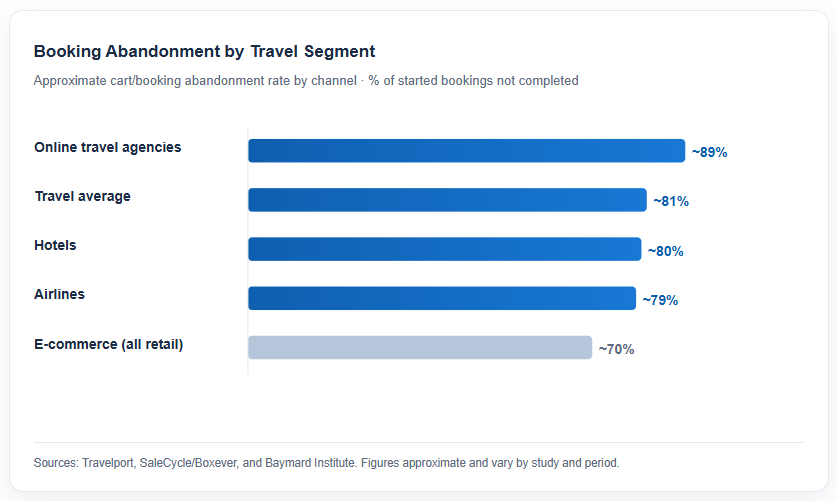
Reservation abandonment happens when a customer starts a booking but never confirms it. The traveler enters the funnel, then exits before payment. It is the travel version of e-commerce cart abandonment, only worse. According to the Baymard Institute, online retail abandonment averages about 70%. Travel, by contrast, sits closer to 81%, per Travelport research. So abandoned reservations are the norm, not the exception.
Several structural factors make travel worse than retail. Bookings cost far more, so travelers deliberate and comparison-shop. A single trip may involve dozens of site visits before purchase. Meanwhile, the funnel itself is long and multi-step. Dates, rooms, add-ons, and payment all create exit points. As a result, hotel booking abandonment and airline drop-off both run stubbornly high.
The Real Cost of Abandoned Reservations
An abandoned reservation is expensive twice over. First, you lose the booking value itself. Second, you lose the marketing spend that delivered the visitor. That traveler arrived through paid search, metasearch, or an email campaign. Each of those channels carries a real acquisition cost. So every abandoned booking wastes money you already spent.
Travel makes this worse because inventory is perishable. An empty room tonight or an empty seat at takeoff earns nothing, ever. Consequently, a low reservation conversion rate quietly erodes revenue you can never recover. Even small gains matter enormously at scale. Lift completed bookings by a few points, and the revenue impact compounds fast.
Why Travelers Abandon Bookings: It’s Friction, Not Price
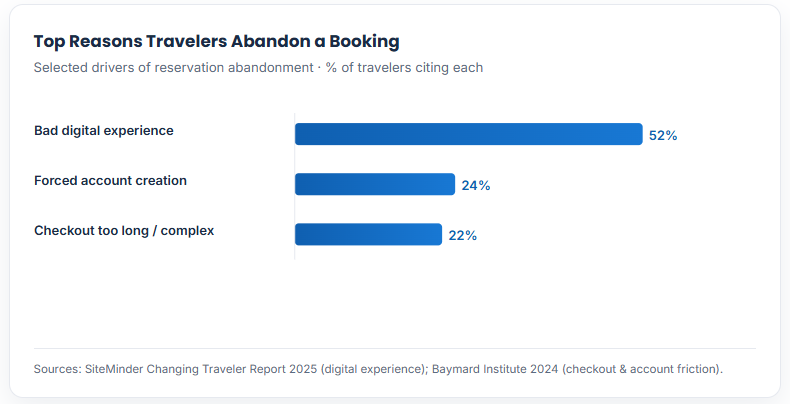
Most travel brands blame their rates. The data tells a different story. The SiteMinder Changing Traveler Report 2025 found that 52% of travelers abandon a booking because of a bad digital experience. That is a majority, and it has nothing to do with price. Baymard’s checkout research adds detail. About 22% of shoppers abandon because the checkout is too long or complicated. Another 24% leave because they are forced to create an account first.
Mobile makes friction even more punishing. Mobile abandonment runs around 85%, against roughly 73% on desktop. Small screens magnify every extra field and slow load. Hospitality strategist Are Morch puts it bluntly, calling experience friction the most overlooked cause of abandonment.
He notes that hotels obsess over pricing while ignoring the booking experience. So the fix rarely starts with a discount. It starts with removing effort and rebuilding trust.
◆ Insight
Price gets the blame because it is easy to measure. Friction gets ignored because it hides inside the funnel. Yet a slow page, a forced login, or a surprise fee kills more bookings than a competitor’s rate ever will. The good news: unlike your rates, friction is entirely within your control to fix.
An Abandoned Reservation Is a Warm Lead, Not a Lost Sale
Here is the mindset shift that changes everything. An abandoned booking is not a lost customer. It is an interested one who got interrupted. The traveler found you, chose you, and started the process. Something small then broke the moment. So the intent was real, even if the booking was not.
Recovery works because that interest survives. Revinate’s 2025 benchmarks show hotel recovery campaigns average a 66% open rate and 10% conversion. In other words, one in ten abandoners will finish if nudged well. The revenue is real, not theoretical. One Revinate client, the luxury retreat Ambiente Sedona, recovered close to $264,000 in direct bookings from a single abandonment campaign. That is money most brands write off entirely.
How Travel Companies Reduce Reservation Abandonment
Reducing abandonment takes two moves working together. First, remove friction from the funnel. Second, add a human safety net where doubt appears. Start with the checkout itself. Offer guest checkout, so no traveler is forced to register. Show total pricing early, with no surprise fees at the final step. Streamline the steps, and make the whole flow mobile-first. These changes lift travel booking conversion before anyone even talks to a person.
Then comes the underrated half: human support at the moment of doubt. Travelers hesitate most when a question goes unanswered. A proactive live chat offer at that instant can rescue the booking. So can a fast, friendly inbound call center for higher-value trips. SkyCom supports travel brands through bilingual customer engagement and multilingual support that meets travelers in their own language. These teams also run abandoned booking recovery, following up quickly while intent is still warm. Explore our travel and hospitality solutions to see how it fits together.
Friction Points and How to Fix Them
| Friction point | Why it causes abandonment | How to fix it |
|---|---|---|
| Forced account creation | Adds effort before any value is delivered | Offer guest checkout |
| Long or complex checkout | Every extra field invites a drop-off | Streamline steps; autofill |
| Hidden fees at the end | Breaks trust at the worst moment | Show total price upfront |
| Slow or clunky mobile flow | Mobile users abandon far faster | Mobile-first, fast-loading design |
| Unanswered questions | Doubt stalls the booking mid-funnel | Proactive live chat & voice support |
| No follow-up after exit | Warm leads cool and disappear | Fast abandoned-booking recovery |
General guidance; impact varies by brand, channel, and traveler segment.
Frequently Asked Questions
What is reservation abandonment in travel?
Reservation abandonment is when a traveler starts a booking but leaves before confirming it. It is the travel equivalent of e-commerce cart abandonment, and it runs higher — around 80% of started travel bookings are never completed.
What is the average travel booking abandonment rate?
Travel abandonment averages about 81%, according to Travelport, compared with roughly 70% for e-commerce overall (Baymard Institute). Online travel agencies run highest at around 89%, with airlines near 79% and hotels around 80%.
Why do travelers abandon bookings?
Mostly friction and lost trust, not price. SiteMinder found 52% abandon due to a bad digital experience, while Baymard cites forced account creation (24%) and long or complicated checkouts (22%) as major drivers.
How can travel companies improve booking conversion?
Remove funnel friction — offer guest checkout, transparent pricing, and a fast mobile flow — then add human support at the point of doubt. Proactive live chat, voice support, and quick abandoned-booking recovery all lift conversion.
Can abandoned reservations really be recovered?
Yes. An abandoned booking is a warm lead, not a lost sale. Revinate’s benchmarks show recovery campaigns average a 66% open rate and 10% conversion, and one hotel recovered close to $264,000 from a single campaign.
Does human support reduce abandonment?
It does. Many travelers abandon because a question went unanswered at a decisive moment. A well-timed live chat or a fast, friendly call resolves that doubt, and multilingual teams keep international travelers engaged in their own language.
Losing bookings to friction and unanswered questions?
SkyCom’s bilingual travel teams provide proactive live chat, voice support, and abandoned-booking recovery — meeting travelers at the moment of doubt to lift your booking conversion, at competitive cost.
Conclusion: Fix the Friction, Recover the Warm Leads
Reservation abandonment is not a pricing problem you must discount your way out of. It is a friction-and-trust problem you can design away. Travelers abandon when the experience feels slow, opaque, or impersonal. So the winners will streamline the funnel and remove every avoidable barrier. Just as importantly, they will treat each abandoned booking as a warm lead worth recovering. Answer the question at the moment of doubt, and follow up fast afterward. Do that, and the industry’s worst-in-class abandonment rate becomes your competitive advantage.