

Manual loan processing looks affordable on the surface. You pay processors, and applications move through the pipeline. Yet the true cost of manual loan processing hides beneath that simple math. Errors, delays, and lost borrowers quietly drain far more than salaries do. In fact, manual loan processing costs pile up in places most lenders never measure. This guide breaks down those hidden loan processing costs. It also shows where the biggest inefficiencies live, and how lenders fix them.
The stakes keep rising as borrowers demand speed. Meanwhile, margins stay thin, and regulation grows heavier. So the gap between manual and modern lenders widens every year. Below, we start with the visible cost, then uncover the hidden ones.

What Manual Loan Processing Actually Costs
Start with the number you can see. Originating a loan is expensive, and people drive most of that cost. According to the Mortgage Bankers Association, personnel expenses make up the majority of total loan production costs. In other words, manual labour is the single largest line item. Every application touched by hand adds processing time, review time, and rework. Consequently, the cost of manual loan processing rises directly with volume. Growth then becomes a cost problem instead of a profit opportunity.
The Hidden Costs Beyond the Payroll Line
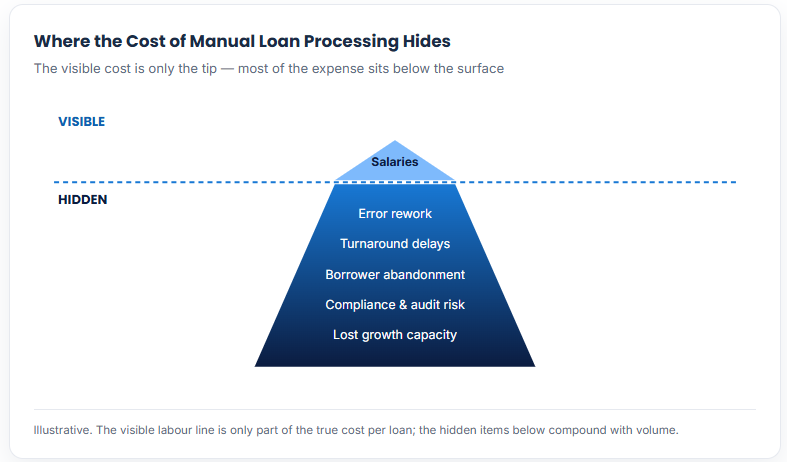
Salaries are only the beginning. The real damage comes from what manual work causes downstream. These are the hidden loan processing costs that rarely appear on a budget.
Errors and Rework
Manual data entry invites mistakes. Industry estimates put manual entry error rates around 3% to 4%. On a loan file with hundreds of fields, small errors multiply fast. Worse, many surface only during quality-control review, sometimes weeks later. Each correction then costs time, money, and momentum. As a result, loan processing errors quietly inflate the true cost per loan.
Delays and Turnaround Time
Manual workflows move at human speed. Applications pass through processing, underwriting, compliance, and closing by hand. Every handoff adds a queue, and every queue adds days. Meanwhile, borrowers now compare lenders on speed above almost everything. So each extra day in the pipeline risks losing the deal. Long loan processing turnaround time is therefore a revenue problem, not just an operational one.
Borrower Abandonment
Speed is no longer a nicety. It is a competitive weapon. A slow, clunky process pushes applicants toward faster rivals. Consequently, manual loan processing delays translate directly into lost originations. The borrower who walks away also takes your marketing spend with them.
Compliance and Risk
Lending is heavily regulated, and manual work strains compliance. Two reviewers can read the same file and reach different conclusions. That variability creates audit risk and inconsistent decisions. Moreover, evolving rules demand accurate, well-documented data every time. Manual processes make that consistency hard to guarantee. For a sense of how fast requirements shift, our CFPB Section 1071 guide shows the moving compliance target lenders now face.
Why Manual Loan Processing Caps Your Growth
Here is the cost nobody puts in a spreadsheet. Skilled staff spend their days on data entry, not decisions. Loan officers chase documents instead of originating new business. Research from Cerulli Associates found that lenders who automate origination workflows process roughly 2.3 times more applications per loan officer. That gap is pure opportunity cost. So manual loan processing does not just cost money. It quietly caps how much you can grow.
◆ The Real Problem
Manual processing scales the wrong way. Add volume, and you add headcount, errors, and delay in lockstep. Modern lending breaks that link — it lets you grow originations without growing cost at the same pace. That is the difference between a process that limits you and one that compounds for you.
Building a Better Loan Processing Workflow
The fix is not simply working harder. It is redesigning the loan processing workflow. Automation and structured processing remove the repetitive, error-prone steps. McKinsey research has found that automation can reduce loan-operations costs by roughly 20% to 30%. Its 2025 credit-workflow pilot improved turnaround by around 30%. Deloitte likewise reports that most firms have embedded automation into core business processes. The direction is clear: manual-only lending is becoming a competitive disadvantage.
Manual vs. Optimised Loan Processing
| Factor | Manual Processing | Automated / Supported Processing |
|---|---|---|
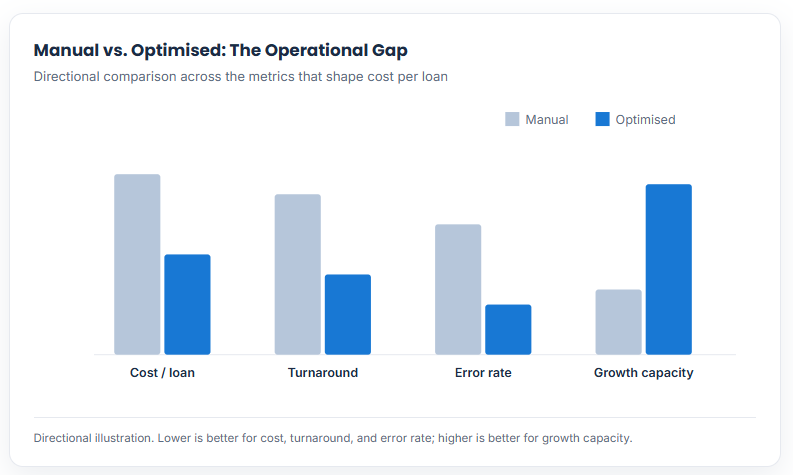
| Cost per loan | High; rises with volume | Lower; scales efficiently |
| Turnaround time | Days to weeks; many handoffs | Faster; fewer handoffs |
| Error rate | ~3–4% data-entry errors | Reduced via validation |
| Scalability | Add headcount to grow | Flex capacity up or down |
| Compliance | Variable; manual documentation | Consistent; auditable |
| Staff focus | Data entry & chasing documents | Credit decisions & growth |
General comparison for guidance; outcomes vary by lender, loan type, and volume.
How Lenders Reduce the Cost of Manual Loan Processing
Technology is only half the answer. Capacity is the other half. Many lenders extend their teams with specialised processing support. That lets them absorb volume without hiring for every peak. SkyCom supports lenders through consumer lending outsourcing, mortgage BPO, and commercial lending outsourcing. Disciplined back-office processing handles data entry, document management, and file preparation. As a result, skilled internal staff focus on credit decisions, not keystrokes. For a broader view, explore our banking, financial services, and insurance solutions.
Frequently Asked Questions
What is manual loan processing?
Manual loan processing is handling loan applications largely by hand — keying in data, chasing documents, reviewing files, and passing them between teams. It relies on human effort at each step rather than automated workflows, which raises costs, delays, and error risk.
What does manual loan processing cost?
Beyond salaries, manual processing carries hidden costs: rework from errors, revenue lost to delays, borrower abandonment, and compliance risk. Personnel expenses already make up the majority of loan production costs, according to Mortgage Bankers Association data, and manual work amplifies them.
What are the hidden costs of manual loan processing?
The highest hidden costs are error rework, slow turnaround, lost borrowers, compliance variability, and opportunity cost. Skilled staff spend time on data entry instead of decisions, which quietly caps how many loans a lender can originate.
How does manual processing affect turnaround time?
Manual workflows add a queue at every handoff between processing, underwriting, compliance, and closing. Those queues accumulate into days or weeks. Because borrowers compare lenders on speed, long turnaround times directly reduce win rates.
Can outsourcing reduce loan processing costs?
Yes. A specialised processing partner absorbs volume and repetitive back-office work without permanent hiring. That lowers cost per loan, speeds turnaround, and frees internal teams for credit decisions, while the lender retains control and compliance ownership.
Is loan processing automation worth it for smaller lenders?
Often, yes. Community and regional lenders tend to have the most manual steps, so they gain the most from automation and structured support. Even partial automation of data entry and document handling can meaningfully cut costs and delays.
Cutting the hidden cost of manual loan processing?
SkyCom’s teams handle loan processing, document management, and back-office support — so your staff focuses on credit decisions, and your cost per loan falls.
Conclusion: Manual Isn’t Cheap, It’s Expensive in Disguise
Manual loan processing rarely looks like a crisis on a budget line. Yet its costs are real, compounding, and mostly hidden. Errors create rework, delays cost deals, and skilled staff stay stuck on keystrokes. Meanwhile, competitors that modernise pull ahead on speed and margin. The lenders who win will treat processing as a strategic capability, not a clerical afterthought. Fix the workflow, and the hidden costs stop hiding.