

Anyone comparing the top telecommunications companies in US markets quickly hits one truth. A handful of giants control almost everything. The largest telecom companies US buyers deal with shape pricing, coverage, and service nationwide. This guide ranks the US telecom industry leaders for 2026 through a business lens. We wrote it for investors, vendors, and partners, not home-phone shoppers.
Here is the scale. US wireless service revenue alone runs near $150 billion a year. Just three carriers hold about 96% of the wireless market. Yet size no longer guarantees loyalty, and that gap defines 2026.
Stat check: Deloitte’s 2026 Telecommunications Industry Outlook warns of a “crisis of customer value and brand loyalty.” Up to 77% of consumers feel no loyalty to their carrier.
How the US Telecommunications Market Is Structured
The US telecom market splits into a few overlapping layers. Wireless carriers sell mobile service to consumers and businesses. Broadband and cable providers deliver home and enterprise internet. Fiber and converged players now blur those lines, bundling mobile with broadband. Understanding these layers matters for anyone selling to, investing in, or partnering with the sector.
The wireless layer is the most concentrated. Three national carriers control roughly 96% of mobile subscribers between them. Cable operators dominate home internet, though fixed wireless and fiber keep chipping away. For B2B readers, this structure explains where margins, churn, and support pressure actually sit.
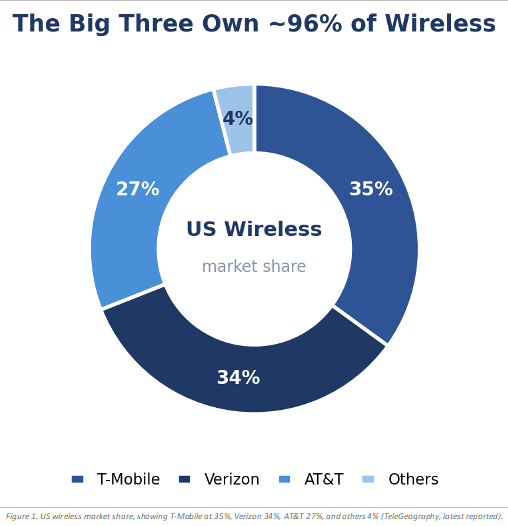
Insight: Three carriers own almost all of wireless, but the fastest-growing mobile lines now come from cable. Xfinity Mobile and Spectrum Mobile are winning subscribers by bundling.
The Top 10 Telecommunications Companies in the US (2026)
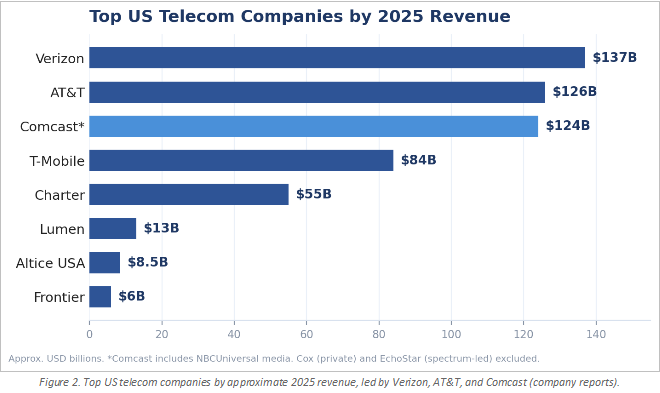
The table below ranks the leaders by scale, using 2025 revenue and reported subscriber figures. Read it as directional, since revenue and customer counts shift every quarter. Company profiles follow with the one move that defines each in 2026.
|
Rank |
Company |
~2025 Revenue |
Scale Snapshot |
Defining 2026 Move |
|
1 |
Verizon |
~$137B |
~146M wireless connections |
Closed Frontier fiber acquisition |
|
2 |
AT&T |
~$126B |
118M+ wireless subscribers |
Largest US fiber build; buying EchoStar spectrum |
|
3 |
T-Mobile |
~$84B |
130M+ connections |
Fastest 5G; highest telecom market value |
|
4 |
Comcast (Xfinity) |
~$124B* |
~31 to 32M broadband customers |
Largest single home-internet base |
|
5 |
Charter (Spectrum) |
~$55B |
~32M customers |
$34.5B Cox merger pending |
|
6 |
Lumen Technologies |
~$13B |
National fiber backbone |
Pure-play enterprise and AI networking |
|
7 |
Cox Communications |
Private |
~6.2M customers |
Merging into Charter |
|
8 |
EchoStar (Boost) |
Spectrum-led |
~7M wireless subscribers |
Sold ~$40B spectrum; hybrid model |
|
9 |
Frontier |
~$6B |
~8M fiber passings |
Acquired by Verizon (closed) |
|
10 |
Altice USA (Optimum) |
~$8.5B |
~4.2M broadband subscribers |
Fiber and mobile push |
Comcast revenue includes its NBCUniversal media businesses.
1. Verizon
Verizon sits at the top of American telecom by revenue. It posted about $137 billion in 2025 and serves roughly 146 million wireless connections. Its network reaches over 99% of the population, which supports premium pricing. In 2026, Verizon closed its Frontier acquisition and now passes more than 30 million fiber locations. For enterprise buyers, that scale and private-5G capability make it a default shortlist name.
2. AT&T
AT&T ranks second, with roughly $126 billion in 2025 revenue and more than 118 million wireless subscribers. It runs the largest fiber build in the country, passing over 31 million locations. Moreover, its convergence play works, since more than 40% of fiber homes also buy AT&T wireless. The Dallas carrier is also buying EchoStar spectrum and Lumen’s consumer fiber to extend that lead.
3. T-Mobile
T-Mobile turned disruption into leadership. Its 2025 revenue passed $84 billion, and independent tests still rank its 5G fastest. Furthermore, it now carries the highest market value of any US telecom. The carrier absorbed UScellular’s wireless business in 2025 and keeps adding postpaid customers faster than rivals.
4. Comcast (Xfinity)
Comcast leads American home internet with roughly 31 to 32 million broadband customers. Its total revenue sits near $124 billion, though that figure includes NBCUniversal media. Meanwhile, Xfinity Mobile keeps adding lines by bundling wireless with home internet. Comcast Business also gives it a serious enterprise connectivity arm.
5. Charter Communications (Spectrum)
Charter’s Spectrum brand reaches about 32 million customers across 41 states. Revenue runs near $55 billion, and Spectrum Mobile has topped 12 million lines. Notably, Charter is buying Cox Communications for $34.5 billion, pending a final California vote. That deal would create the largest US broadband provider, serving nearly 38 million customers.
6. Lumen Technologies
Lumen plays a different game built on enterprise connectivity. It sold its consumer fiber to AT&T and now runs a pure enterprise networking business. Revenue sits near $13 billion, resting on a vast national fiber backbone. In fact, large deals to connect AI data centers gave Lumen fresh momentum into 2026. CEO Kate Johnson frames the goal as networking for a “multi-cloud, AI-first world.”
7. Cox Communications
Cox is the largest privately held broadband provider in America. It serves about 6.2 million residential and business customers across 18 states. Because it stays private, Cox does not report public revenue like its peers. Its pending merger into Charter signals just how fast cable is consolidating.
8. EchoStar (Boost Mobile)
EchoStar owns Boost Mobile, which serves around 7 million wireless subscribers. In 2025, the company sold roughly $40 billion in spectrum to AT&T and SpaceX. As a result, Boost is shifting to a hybrid model that leans on AT&T’s network. Still, it keeps competing hard on price, and now eyes satellite direct-to-cell service.
9. Frontier Communications
Frontier reinvented itself as a pure-play fiber provider with roughly 8 million fiber passings. Its fiber-first turnaround proved so convincing that Verizon acquired it for about $20 billion. That deal closed in 2026, so Frontier now operates inside Verizon. Consequently, its network anchors much of Verizon’s expanded fiber footprint.
10. Altice USA (Optimum)
Altice USA serves about 4.2 million broadband subscribers under the Optimum brand. It operates across 21 states, with its core in the New York tri-state area. Revenue ran near $8.5 billion in 2025 amid heavy fiber competition. In response, the company is racing to expand fiber and mobile while defending its base.
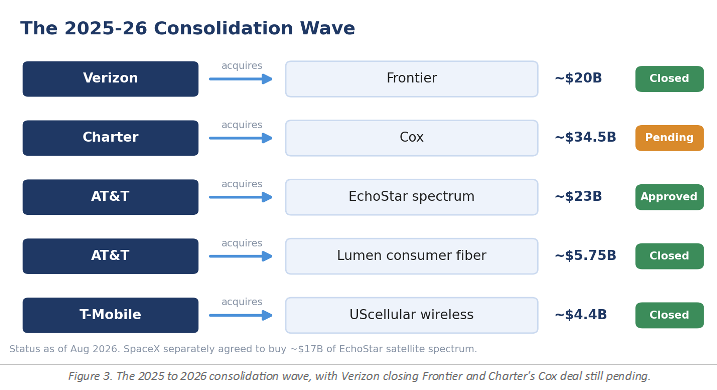
Insight: Every megadeal here buys the same two things, fiber and spectrum. Scale keeps consolidating, yet the customer-experience gap stays wide open.
The Customer Experience Challenge Facing Telecom Leaders
Every company above shares one structural weakness. Scale does not buy loyalty anymore. Deloitte’s 2026 outlook calls it a “crisis of customer value and brand loyalty.” Its research finds up to 77% of consumers feel no real loyalty to a provider. Only about 47% stay with their main carrier beyond five years.
The numbers behind that gap are brutal. Telecom churn sits near 22% a year, among the worst of any industry. PwC’s customer experience research adds that 52% of people quit a brand after bad experiences. Because winning a new subscriber costs far more than keeping one, every defection hurts twice. An eSIM now lets a frustrated customer leave before the hold music ends. Consequently, reducing telecom churn has become the real competitive battleground.
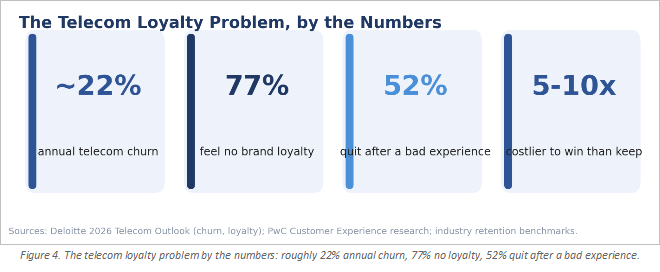
Insight: Retention is a margin lever, not a support cost. A single point of churn reduction can lift profit sharply. Winning a customer costs far more than keeping one.
Support Quality Drives Much of That Movement
Support quality drives much of that movement. Billing confusion, slow fixes, and clumsy handoffs push customers toward the exit. This challenge is industry-wide, and it hits the biggest names as hard as the small ones. So the contact center will decide the next reshuffling of these telecommunications leaders.
What Smaller and Mid-Market Telecom and ISP Providers Can Learn
Here is the twist for most readers. You probably do not run one of the ten giants above. Mid-market carriers, regional ISPs, and MVNOs compete against companies with enormous internal support machines. Matching that headcount dollar for dollar is impossible. So the smart players compete on experience instead of scale.
Nearshore outsourcing is the lever they use to do it. It gives a mid-market provider enterprise-grade support without an enterprise payroll. Bilingual teams in aligned time zones handle billing, activations, and technical calls at lower cost. For example, telecom contact center KPIs improve fastest when specialists own the queue. Proactive outreach then turns at-risk accounts into renewals.
The same logic covers newer, harder workloads. Scaling 5G technical support demands agents who can explain fixed wireless, IoT, and device quirks calmly. Broadband and ISP care lives or dies on first-call resolution. Meanwhile, telecom billing support quietly decides whether a confusing invoice becomes a cancellation. Done well, that kind of support lets small players punch far above their weight.
The Real 2026 Battleground for US Telecom Leaders
The ranking tells a clear story. A few giants still control the top telecommunications companies in US markets. Consolidation is tightening that grip, as Verizon absorbs Frontier and Charter pursues Cox. Yet raw scale no longer decides who wins the next customer.
Customer experience does. Churn, billing, and support quality now separate the leaders from the laggards. For everyone outside the top ten, that reality is actually good news. Smart support can level a field that headcount alone never will.
Compete on Experience, Not Headcount
Your telecom or ISP business can rival the giants on customer experience without their payroll. SkyCom builds bilingual, nearshore telecom support teams that cut churn and lower cost-to-serve. Our specialists handle billing, activations, technical support, and proactive retention around the clock. Let’s talk about competing on experience, not headcount.