
A handful of giant payers now cover most insured Americans. Here are the largest health insurance companies in the US, ranked by membership — and the forces quietly rewriting the leaderboard this year.
The top health insurance payers in the US decide how nearly every insured American reaches care. A small group of health insurance companies now dominates the market. In fact, the largest health insurance payers control most commercial, Medicare, and Medicaid membership nationwide. That concentration shapes premiums, provider networks, and member experience for tens of millions of people. Employers feel it, providers feel it, and patients feel it most of all. This guide ranks the biggest US health insurers by membership for 2026. More importantly, it explains the shifts reshaping who leads and why.
Scale in this industry is staggering. More than 35 million people sit in Medicare Advantage plans alone, according to KFF’s 2026 enrollment analysis. Add commercial, Medicaid, and marketplace coverage, and the numbers climb into the hundreds of millions. Consequently, a single ranking spot can represent millions of lives and billions in premiums. Below, we rank the top 20, then dig into the trends behind the table.
The Largest Health Insurance Companies in the US, Ranked
The leaderboard rewards diversification. The biggest US health insurers spread membership across employer plans, government programs, and the individual market. As a result, they weather policy swings better than single-line specialists. Here are the ten largest, followed by the rest of the top 20.
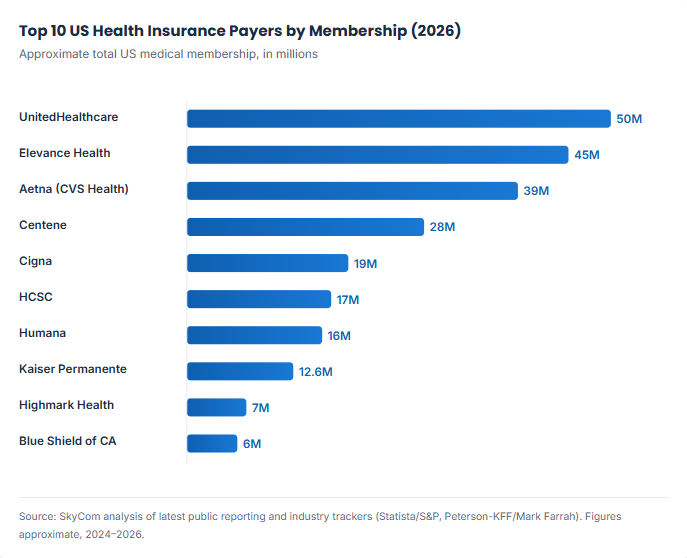
Insight: Look at the drop-off. The membership gap between the number-one and number-ten payer runs nearly eightfold. That steep curve explains the industry’s appetite for mergers. Scale lowers per-member cost, and lower cost funds the next acquisition. In short, size begets size.
1. UnitedHealthcare (UnitedHealth Group)
~50 million members · Largest by revenue
UnitedHealthcare stands as the nation’s largest health insurer as a single company. It also leads by revenue, and the gap is wide. Its plans span employer, individual, Medicare Advantage, and Medicaid coverage. Moreover, its Optum sibling handles pharmacy, data, and care delivery. Together they form the most vertically integrated payer in America.
2. Elevance Health (formerly Anthem)
~45 million members · Blue plans in 14 states
Elevance ranks among the largest Blue Cross Blue Shield licensees. It runs Anthem-branded plans across 14 states, plus its Carelon services arm. The company rebranded from Anthem in 2022, proving even insurers enjoy a makeover. Meanwhile, it balances a deep commercial book with sizable Medicaid and Medicare membership.
3. Aetna (CVS Health)
~39 million members · CVS-integrated
CVS Health acquired Aetna in 2018, and the two now operate as one. Members tap CVS pharmacies and MinuteClinics through connected benefits. Employer plans anchor the book, while Medicare Advantage enrollment keeps climbing. As a result, Aetna sits comfortably in the top tier by total membership.
4. Centene
~28 million members · Medicaid & marketplace leader
Centene dominates government-sponsored coverage across the country. It leads in Medicaid managed care and ranks among the top ACA marketplace insurers. Its Ambetter brand carries much of that marketplace weight. Therefore, providers serving Medicaid and subsidized populations rarely skip Centene networks.
5. Cigna (The Cigna Group)
~19 million members · Employer-focused
Cigna specializes in employer-sponsored and specialty coverage. Its Evernorth arm runs pharmacy and behavioral health services. Large corporations often favor its broad national network. In addition, its global footprint gives multinational employers a single partner across borders.
6. HCSC (Health Care Service Corporation)
~17 million members · Largest customer-owned insurer
HCSC is the largest customer-owned health insurer in the country. It operates Blue Cross Blue Shield plans in Illinois, Texas, Montana, New Mexico, and Oklahoma. Strong local network positions define its markets. Consequently, employers in those states often default to an HCSC-backed plan.
7. Humana
~16 million members · Medicare Advantage powerhouse
Humana builds its business around Medicare. It ranks as one of the two dominant Medicare Advantage insurers nationwide. The company invests heavily in home-based care and chronic-condition management. Notably, Humana was one of only two large insurers to grow Medicare Advantage membership in 2026.
8. Kaiser Permanente
~12.6 million members · Integrated care model
Kaiser Permanente is both insurer and care provider in one system. It operates across eight states plus Washington, D.C. Its unified model pairs plans, hospitals, and physician groups under one roof. As a result, it consistently earns high member-satisfaction marks inside its service areas.
9. Highmark Health
~7 million members · BCBS in PA, WV, DE, NY
Highmark ranks among the largest Blue Cross Blue Shield organizations. It serves commercial, individual, and government members across a multi-state footprint. Its Allegheny Health Network adds provider capacity to the plan side. Therefore, Highmark competes as both payer and integrated system.
10. Blue Shield of California
~6 million members · California-focused
Blue Shield of California is a large nonprofit Blues plan. It concentrates in California with a broad commercial base. The plan also grows across the state’s Medicare and Medicaid programs. Meanwhile, it has pushed publicly for pharmacy and cost-transparency reforms.
Fast-facts sources: FY2024 revenue for publicly traded payers via the Fortune 500 (Becker’s Hospital Review); customer-owned and nonprofit revenue figures (HCSC, Highmark, Kaiser, Blue Shield of California) are approximate, from company reporting. HQ and founding details from company disclosures.
Ranks 11 to 20: The Regional Blues and Medicaid Specialists
The next tier blends regional Blue Cross Blue Shield plans with government-focused managed care organizations. Molina Healthcare holds roughly 5.6 million members and specializes in Medicaid, Medicare, and marketplace coverage. CareSource follows closely at about 5.6 million as one of the largest nonprofit Medicaid organizations. GuideWell, parent of Florida Blue, serves around 5 million in a state with the nation’s highest marketplace enrollment. Blue Cross Blue Shield of Michigan leads its home state with roughly 5 million members across commercial and government lines.
Provider-owned plans also crowd this tier. UPMC Health Plan covers about 4.5 million through its Pennsylvania delivery system. Blue Cross Blue Shield of North Carolina leads its state at roughly 4 million members. Independence Blue Cross anchors the Philadelphia region near 3.7 million. Horizon Blue Cross Blue Shield of New Jersey matches that scale statewide. Point32Health, the merger of Harvard Pilgrim and Tufts, serves about 2.2 million across New England. Finally, EmblemHealth covers roughly 3 million in the New York market. Ultimately, these regional leaders often outperform national giants on local trust and network depth.
Why the US Health Insurance Market Keeps Consolidating
American health coverage runs on acronyms — HMO, PPO, EPO, and D-SNP form a veritable alphabet soup. Behind that soup sits relentless consolidation. The five largest health insurance companies alone control roughly half the market. Scale buys negotiating power with hospitals and drugmakers. Moreover, it spreads fixed technology and compliance costs across more members.
Vertical integration accelerates the trend. Payers now own pharmacies, clinics, data platforms, and physician groups. Consequently, the line between insurer and provider keeps blurring. Deloitte captures the moment in its 2026 US Health Care Outlook. It urges leaders to join forces with other industries to unlock innovation.
Smaller plans, meanwhile, must specialize or partner to survive.
Medicare Advantage Is Rewriting the Payer Leaderboard
Medicare Advantage has become the industry’s main battleground. Enrollment topped 35 million in early 2026, per CMS data analyzed by KFF. Yet growth has clearly slowed after nearly two decades of expansion. Notably, only Humana and Kaiser Permanente grew enrollment among the five largest insurers this year.
The reshuffle is real, not theoretical. UnitedHealthcare told investors it expects to shed 1.3 to 1.4 million Medicare Advantage members in 2026. In response, it is trimming plans, narrowing networks, and raising premiums to protect margins. When national carriers exit counties, regional and provider-sponsored plans often rush in. As a result, the leaderboard’s lower ranks could look very different by 2027.
A single ranking spot in this market can represent millions of lives — and the operational machine required to serve them.
The Margin Squeeze Payers Cannot Ignore in 2026
Size does not guarantee comfort. Health plan margins recently hit their lowest level in two decades, according to PwC. Its aptly titled report, “Future of Payers: Half the Cost, Twice the Service,” frames the challenge perfectly. PwC projects a 2026 medical cost trend of 8.5% for group plans and 7.5% for individual plans. Meanwhile, utilization keeps climbing, and regulatory pressure keeps building.
Leaders feel the strain. Deloitte found that 43% of health care executives felt uncertain or neutral about 2026, up from 28% a year earlier. Rising costs collide with member expectations that keep accelerating. In fact, roughly one in three adults now turns to AI for health information, Deloitte reports. Therefore, payers must cut cost and lift service at the same time — the exact tension PwC named.
How Payers Are Rethinking Operations and Member Experience
The math forces a hard question. How do payers serve more members, faster, for less? Increasingly, the answer runs through operations, not just pricing. Over 80% of health care executives are leaning into agentic AI, per Deloitte. They target claims automation, prior authorization, and member support. Above all, they want to reduce administrative burden without gutting the human touch.
Insight: Here is the quiet truth of the 2026 leaderboard. Premium pricing is largely capped by regulation and competition. Therefore, the next dollar of margin hides in operations, not in rate increases. The back office has become the real battleground. Payers who industrialize claims and member service will out-earn rivals of identical size.
Outsourcing sits at the center of that strategy. Enrollment surges hit hard every fall, and staffing to the peak wastes money year-round. A specialized partner absorbs those spikes and holds service levels steady. For example, bilingual nearshore teams can run member services and back-office work at a fraction of onshore cost. SkyCom supports exactly these functions through its healthcare payer solutions and health plan outsourcing. Consequently, payers offload volume while keeping HIPAA-grade control of the work.
The heaviest load lives in the back office. Claims processing, insurance verification, and prior authorization consume enormous staff time. These tasks spike, follow strict rules, and punish errors. Meanwhile, compliance never sleeps, as our breakdown of the 2026 HIPAA Security Rule makes clear. A disciplined outsourcing model turns that grind into predictable, measurable throughput.
What This Means for Providers and Health Plans
The same ranking doubles as a strategy map for providers. These payers drive the majority of reimbursement across the country. Therefore, credentialing and clean claims with them shape cash flow directly. A denied claim from a top payer hurts far more than a small one. As a result, revenue-cycle discipline matters most with the largest networks.
Health plans face the mirror-image challenge. They must grow membership while defending razor-thin margins. Member experience now separates winners from churners. Indeed, a frustrating call or slow verification can trigger a switch during open enrollment. Ultimately, the payers that master operations and experience will climb this list — and the rest will slide. For a related view of scale across finance, see our companion ranking of the top financial institutions in the US.
Frequently Asked Questions
Who is the largest health insurance payer in the US?
UnitedHealthcare, part of UnitedHealth Group, is the largest single company by both membership and revenue. Counted collectively, the independent Blue Cross Blue Shield companies cover more members than any single national carrier.
How many health insurance payers dominate the US market?
Roughly five companies control about half the market: UnitedHealth Group, Elevance Health, CVS Health/Aetna, Centene, and Humana. Regional Blue Cross Blue Shield plans and Medicaid specialists fill out the rest of the top 20.
Which payers focus on Medicare and Medicaid?
Humana and Aetna are major Medicare Advantage insurers, while UnitedHealthcare leads overall. Centene, Molina, and CareSource concentrate heavily on Medicaid managed care and ACA marketplace coverage.
Why is Medicare Advantage enrollment slowing in 2026?
Rising costs and margin pressure pushed insurers to trim plans and benefits. UnitedHealthcare alone expects to lose over one million members as it prioritizes profitability, according to CMS and KFF data.
How current are these membership figures?
Figures reflect the latest available public reporting and industry trackers, generally covering 2024 to 2026. Membership shifts continually with enrollment cycles and contract changes, so treat the numbers as approximate.
Conclusion: Scale Is the Story, but Operations Decide the Winners
The top health insurance payers in the US command breathtaking scale. Yet 2026 proves that scale alone no longer guarantees a lead. Margins sit at a two-decade low, and Medicare Advantage growth has stalled. Meanwhile, members expect faster, smarter, more personal service every year. The payers that win will pair size with operational excellence. They will automate the routine, outsource the surges, and protect the human moments that build loyalty. Ultimately, this leaderboard will keep shifting — and the organizations that master cost and experience together will define its next edition.