

Most call centers already run quality assurance. Evaluators score calls, agents receive a number, and a report goes to leadership each month. Yet customer satisfaction often stays flat. The scores rise, and nothing the customer feels changes. That gap is the real problem with most call center quality assurance programs.
This guide shows how to close it. It treats QA as an operating system, not a scoring form. You will learn how to write observable standards, then build and pilot a weighted scorecard. It also covers risk-based sampling, calibration, governance, coaching, AI, and a QA scorecard template you can adapt. The aim is simple: a program where a better score means a better customer experience.
What Call Center Quality Assurance Actually Measures
Call center quality assurance is the process of reviewing customer interactions against a defined standard. Evaluators listen to calls or read chats, score them on a scorecard, and use the results to coach agents. Quality monitoring is the narrower step of observing and recording those interactions. QA adds the standard, the scoring, and the follow-through. Done well, it answers two questions. Did the agent do the right things? And did those things help the customer?
Most programs answer only the first question. They check whether the agent used the greeting, verified identity, and read the closing script. Those behaviors matter, but they are inputs. The outcome is whether the customer got an accurate answer with little effort. A strong program measures both, and it weights them so the outcome counts most.
Standards bodies treat quality as part of the whole operation, not a side task. ISO 18295-1 sets service requirements for customer contact centers, whether in-house or outsourced. In other words, QA is one control inside a wider service system. It works best when it connects to training, workforce planning, and process fixes.
Why Most QA Programs Fail to Move CSAT
Customers notice when quality stalls. Deloitte Digital published its 2026 Global Contact Center Survey this year. More than half of consumers said service quality stayed the same or got worse in 2025. Fewer than one in five leaders felt their current strategies were fully effective. Meanwhile, consumers estimated they spend 36% more with companies that give great service.
Five patterns usually explain the gap. First, the scorecard rewards script compliance more than resolution. Second, the criteria are vague, so evaluators score the same call differently. Third, the sample is too small or too random to show real risk. Fourth, scores never turn into coaching, so behavior does not change. Finally, nobody owns the scorecard, so disputes go unresolved and agents stop trusting the result. Each problem has a fix, and the steps below address them in order.
How to Build a Call Center Quality Assurance Program in 10 Steps
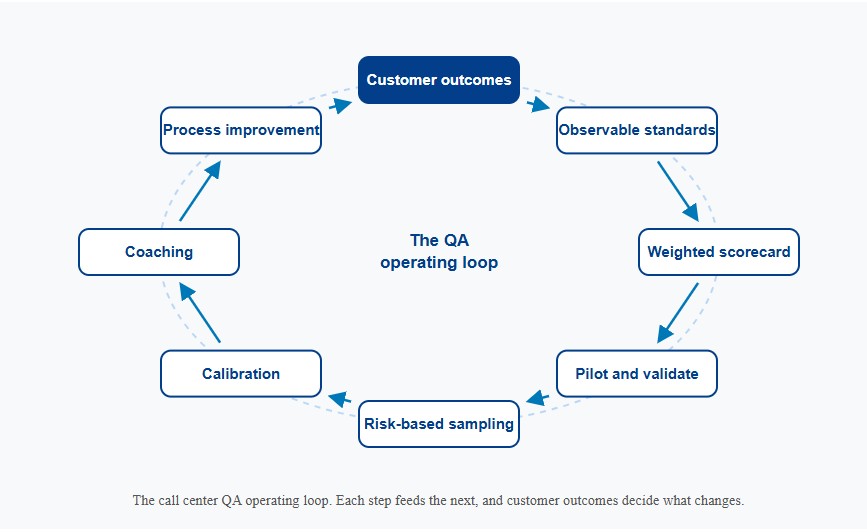
A QA program is a closed loop, not a form. Customer outcomes set the standards, and the standards shape the scorecard. The scorecard then drives sampling, calibration, and coaching. Finally, coaching has to show up in customer results, which feeds the next review. The ten steps below follow that loop.
Step 1: Define the Outcomes You Want
Begin with the customer, not the script. List the three or four outcomes that matter most for your contacts. Typical outcomes are an accurate answer, a resolution on the first contact, low customer effort, and full compliance. Then decide which agent behaviors drive each outcome. Those behaviors become the criteria on your scorecard.
Step 2: Define Observable Quality Standards
Every criterion should pass one test. What would an evaluator hear, see, or verify that proves the agent met it? Criteria such as “agent was professional” fail that test. Two evaluators will read them differently, and agents cannot tell what to change. Observable criteria fix both problems. They also make automated scoring possible later.
| Weak criterion | Observable criterion |
|---|---|
| Agent was professional | Agent acknowledged the customer’s stated concern before proposing a solution |
| Agent showed empathy | Agent used an appropriate acknowledgment after the customer described the problem |
| Agent provided good service | Agent confirmed the resolution with the customer before closing |
| Agent followed the process | Agent completed required identity verification before accessing account information |
| Agent communicated clearly | Agent explained the next step without unexplained technical terms |
Rewrite each criterion until two evaluators would score it the same way without discussion. This takes time up front. However, it saves months of disputes once scores start to count.
Step 3: Build a Weighted Quality Assurance Scorecard
Weighting tells agents what matters. If every item counts equally, a polite greeting carries the same weight as a wrong answer. Instead, give the largest weight to resolution and accuracy. Then add a short list of auto-fail items that zero the score, whatever else happened. The template later in this guide shows one way to structure it.
Step 4: Pilot the Scorecard Before Using It for Performance Management
Do not attach a new scorecard to performance reviews right away. Test it on real interactions first. Have at least two evaluators score a representative set of contacts across your main contact types. Then look for criteria that everyone passes and criteria that cause frequent disagreement. Also check whether high scores line up with good survey results.
| Pilot finding | What it usually means | Action |
|---|---|---|
| 100% pass rate | The criterion adds little information | Remove or rewrite it |
| High evaluator disagreement | The criterion is ambiguous | Make it observable |
| High score but low CSAT | The weighting is wrong | Reweight toward resolution and effort |
| Frequent N/A ratings | The criterion is too broad | Split it by interaction type |
| Frequent compliance failures | The control needs more force | Make it an auto-fail item |
Revise the scorecard before you connect scores to coaching plans, incentives, or corrective action. Run the pilot long enough to cover your main contact types. Include both peak and quiet periods, because agent behavior changes under load.
Step 5: Build a Risk-Based Sampling Strategy
Sampling is a measurement strategy, not a quota. Consider an agent who handles 1,000 contacts a month. Reviewing five of them covers 0.5% of that agent’s work. Pooled across a team, small samples can still show trends. However, they are too thin for a high-stakes decision about one person.
So build three layers. Random sampling measures overall performance without reviewer bias. Targeted sampling pulls escalations, repeat contacts, low CSAT, and unusually long interactions. It also covers new agents and recently coached agents. Risk-based sampling, the third layer, covers contacts where failure costs the most.
Risk depends on your business. Payment handling, identity verification, regulated disclosures, collections, and healthcare calls carry compliance risk. Cancellations, refund requests, repeated complaints, and competitor mentions carry churn risk. Not every interaction has the same impact, so coverage should follow the cost of failure. Report random and targeted results separately, because targeted samples skew low by design.
Step 6: Calibrate Evaluators and Build a Golden Interaction Library
Calibration keeps the score honest. Each month, several evaluators score the same interactions independently. Then they compare results and agree on the right answer for each criterion. Set a tolerance, for example five points, and retrain anyone outside it. Agents also benefit from joining a session now and then, because it shows them how scoring works.
Calibration works better with a shared reference set. Build a golden interaction library of scored, annotated examples. Include excellent calls, borderline calls, compliance failures, poor resolutions, and strong recoveries. If you use AI, add weak bot-to-agent handoffs too. Then use the library to train new evaluators, test scorecard changes, and onboard agents. Over time, it becomes your quality standard in practice.
Step 7: Set Up QA Governance and Agent Appeals
QA scores affect coaching, incentives, and sometimes employment decisions. That makes governance essential. Name one owner for the scorecard, with operations, training, and compliance as reviewers. Define who can change a criterion and who approves each change. Then version the scorecard and tell agents what changed and why.
Agents also need a formal appeal path. Let them dispute an evaluation within a set window, and have a second evaluator review it. Record each calibration ruling and appeal outcome as a scoring precedent. Those precedents settle future disputes quickly. Track the appeal rate, too. A rising rate usually points to an unclear criterion, not to difficult agents.
Step 8: Turn QA Findings Into Coaching
A score without a conversation changes nothing. Supervisors should coach on one or two behaviors at a time, using the recorded interaction as evidence. Agree on a specific action, then check it in the next review cycle. Recognize improvement as well as gaps. As a result, agents see QA as support rather than surveillance.
Measure the agent side of QA as well. Useful signals include the time from a QA finding to coaching and repeat coaching on the same issue. Score change after coaching matters too. A program can lift customer results while it erodes agent trust. Timely, consistent, and fair feedback prevents that.
Step 9: Connect QA to Customer Outcomes
Compare QA scores with what customers actually report. Match evaluated interactions to their post-contact survey results where you can. Track customer effort score (CES) alongside CSAT, because effort captures friction that satisfaction can miss. Repeat contacts within a few days are another honest signal. If high QA scores sit beside low CSAT, the scorecard measures the wrong things. In that case, revise the criteria, not the agents.
Step 10: Review and Update the Program Every Quarter
Products, policies, and channels change, so the scorecard must change too. Each quarter, remove criteria that every agent passes. Add criteria for new failure points that coaching and complaints reveal. For example, Gartner found that 60% of agents fail to promote self-service. When agents did mention it, 12% made negative remarks. If self-service matters to your strategy, that behavior belongs on the scorecard. Update the golden library and the scorecard version at the same time.
A Quality Assurance Scorecard Template You Can Adapt
The template below works for most voice and chat programs. Weights total 100, and auto-fail items override everything else. Each section uses observable criteria, so evaluators and automated tools can score it the same way. Adjust the sections to match your outcomes from Step 1.
| Section | Weight | Observable criteria |
|---|---|---|
| Opening and verification | 10 | Completed required identity verification before accessing protected information; set clear expectations |
| Discovery | 20 | Asked the questions needed to identify the actual issue; confirmed the issue before solving |
| Resolution and accuracy | 30 | Gave information that matches policy; followed the documented process; resolved the issue or recorded a next action with an owner |
| Customer experience | 20 | Acknowledged the stated concern; explained steps without unexplained jargon; avoided unnecessary holds and transfers |
| Process and documentation | 10 | Recorded an accurate disposition and the required notes; logged follow-ups with an owner and date |
| Closing | 10 | Confirmed the resolution; explained next steps and timing; checked for other needs |
| Auto-fail items | Score becomes 0 | Disclosure before verification, card security code recorded, required disclosure missed, misrepresentation, abusive conduct |
Score each criterion as met, partly met, or not met. Allow a “not applicable” option too. That keeps evaluators from penalizing an agent for steps the call never needed. The downloadable version breaks these sections into 18 criteria and calculates the weighted score automatically. It also includes calibration and pilot worksheets.
How to Extend Call Center Quality Assurance Across Every Channel
Customers do not experience voice QA or chat QA. They experience one brand across every channel they use. So keep one set of core quality principles, then adapt the criteria to each channel. Accuracy and resolution apply everywhere. Response time, concurrency, and consent rules differ by channel.
| Channel | What QA should evaluate |
|---|---|
| Voice | Accuracy, resolution, tone, identity verification, required disclosures |
| Live chat | Response time, accuracy across concurrent chats, clarity of written answers |
| Completeness, accuracy, resolution in one reply, response time | |
| SMS | Clarity, timing, opt-in and opt-out handling |
| Social messaging | Brand voice, moving private details to a secure channel, escalation |
| AI chatbot to agent | Context transfer, ownership of the issue, recovery when the bot failed |
Pay special attention to handoffs between channels and from bots to agents. Customers dislike repeating themselves. So score whether the agent picked up the history and took ownership of the outcome.
Compliance Items Every QA Scorecard Needs
Quality assurance is also a compliance control, so the auto-fail list should reflect your regulators. Payment card data is the most common example. The PCI Security Standards Council states that call recordings must not contain sensitive authentication data after authorization. Therefore QA teams should confirm that recording pauses or redaction worked. A captured security code should be an auto-fail.
Regulated industries add their own checks. Health plans face direct monitoring of call quality. CMS runs a call center monitoring program, described in its memo for the 2022 study. It scores the accuracy of plan information that agents give. It also tests interpreter access within eight minutes, and those results feed Star Ratings. Healthcare teams should also score identity verification before any discussion of protected health information.
Collections programs need yet another layer. Scorecards there should check required disclosures and contact-frequency rules. Our guide to Regulation F call frequency limits explains one of those rules. For healthcare, our article on HIPAA-compliant patient support services covers the verification steps worth scoring.
Where AI Fits in Call Center Quality Assurance
AI changes the coverage problem from Step 5. Speech and text analytics can review every interaction, not a small sample. They flag missed disclosures, long silences, negative sentiment, and repeat contacts automatically. Still, AI should expand QA coverage, not replace QA judgment. The table compares the four common models.
| QA approach | Best use | Limitation |
|---|---|---|
| Manual QA | Complex judgment, coaching, disputed evaluations | Limited coverage |
| Automated QA | Coverage across large interaction volumes | Needs well-defined, observable criteria |
| Hybrid QA | Automated detection plus human judgment | Needs clear governance |
| Real-time QA | Intervention during the interaction | Needs mature technology and workflows |
What AI Should Score and What Humans Should Judge
Automation works best when a criterion has observable evidence. That is why Step 2 matters so much. A criterion such as “verified identity before accessing the account” is easy to detect. A vague one such as “showed empathy” is not.
| AI is well suited to | Human review is better suited to |
|---|---|
| Required phrase and disclosure detection | Complex judgment calls |
| Verification events | Nuanced empathy |
| Silence and hold detection | Ambiguous situations |
| Sentiment signals | Contextual fairness |
| Repeat-contact patterns | Root-cause interpretation |
| Process adherence checks | Appeals and coaching conversations |
Real-Time QA and Coaching
Post-call QA finds what went wrong after the fact. Real-time tools can prompt agents during the interaction instead. Typical triggers are a missed verification step, rising frustration, or long silence. Reserve live prompts for clear, high-confidence signals, since constant alerts distract agents. Our article on AI QMS call center solutions explains how these tools work in practice.
However, AI does not replace calibration. Automated scores still need human review against the same standard, or they drift. AI also creates new interactions to assure. Gartner found that 87% of customers say companies using GenAI must offer a human agent. So QA should cover the handoff from bot to agent, including whether the agent picked up the context.
Metrics That Show Your QA Program Is Working
A QA program needs its own scorecard. The average QA score alone proves little, because scorecards can be easy. Instead, track three groups of measures together. Our industry guides to telecom contact center KPIs and technical support KPIs cover the wider operational metrics.
| Group | Metric | What it tells you |
|---|---|---|
| Customer outcomes | CSAT | Whether QA reflects how customers feel |
| Customer outcomes | Customer effort score (CES) | Whether interactions are easy for customers |
| Customer outcomes | First contact resolution | Whether the problem was solved |
| Customer outcomes | Repeat contact rate | Whether the resolution held |
| QA program health | Coverage rate | How much interaction volume QA sees |
| QA program health | Calibration variance | Whether evaluators agree |
| QA program health | Auto-fail rate | Compliance risk across the team |
| QA program health | Appeal rate | Whether criteria are clear and trusted |
| Agent performance | QA score trend | Whether individual quality is improving |
| Agent performance | Post-coaching improvement | Whether coaching changes behavior |
Review customer outcomes with leadership each month. Program health metrics belong with QA and training leads. Agent metrics belong in coaching conversations, where they can drive action. Similarly, a falling auto-fail rate shows compliance improving, even when overall scores move slowly.
What If QA Scores Rise but CSAT Falls?
This example is illustrative, not drawn from a client. Suppose a contact center lifts its average QA score from 84% to 93% over two quarters. In the same period, CSAT falls from 88% to 82%. Leadership asks why agents score better while customers feel worse. The table shows how to read the signals.
| Observation | Likely problem |
|---|---|
| Script adherence scores rose sharply | The scorecard overvalues script compliance |
| Resolution scores stayed flat | The core customer problem remains unsolved |
| Average handle time increased | Agents follow scripts too rigidly |
| Repeat contacts increased | Answers did not hold |
| Customer effort worsened | Experience criteria are underweighted |
The wrong response is to push agents for an even higher QA score. Instead, revisit the scorecard. Shift weight from scripted steps toward resolution and effort, then pilot the change as in Step 4. A higher QA score is not the same as higher quality. Only customer outcomes can prove that.
Download the free call center QA scorecard template
Get the editable scorecard with observable criteria, weighted scoring, and auto-fail rules. It also includes calibration, pilot, and QA-to-CSAT worksheets.
Conclusion
The goal of call center quality assurance is not a higher QA score. The goal is a measurable improvement in customer and business outcomes. That takes a closed loop: observable standards, a piloted scorecard, risk-based sampling, and regular calibration. It also takes fair governance, coaching that changes behavior, and steady checks against CSAT and effort. Without those pieces, QA becomes a monthly report that nobody acts on.
Building that program takes evaluators, analysts, and supervisors with time to coach. If your team lacks that capacity, a partner can run it alongside your operation. Our nearshore call center services include QA, calibration, and coaching in every program. You can also review the standards we hold on our certifications page.
Frequently Asked Questions
What is call center quality assurance?
Call center quality assurance is the review of customer interactions against a defined standard. Evaluators score calls and chats on a scorecard, then use the results to coach agents. A strong program measures both agent behaviors and customer outcomes. It also checks compliance with rules such as payment card and privacy requirements.
What is the difference between quality assurance and quality monitoring?
Quality monitoring is the process of observing, recording, or analyzing interactions. Quality assurance evaluates those interactions against defined standards and uses the findings to improve performance. Modern QA combines monitoring with structured scoring, calibration, coaching, and outcome measurement.
What should a quality assurance scorecard include?
A good scorecard covers opening and verification, discovery, resolution and accuracy, customer experience, documentation, and closing. It weights resolution and accuracy most heavily. Every criterion should be observable, so two evaluators score it the same way. It also lists auto-fail items, such as disclosing account details before verification.
How many calls should QA review per agent?
There is no single right number, because sampling is a measurement strategy rather than a quota. Combine random samples with targeted and risk-based samples. Targeted samples include escalations, repeat contacts, and low survey scores. Risk-based samples cover payments, disclosures, cancellations, and other costly failures.
Should call center QA review every call?
Not through manual review. Manual QA remains best for judgment-heavy evaluations and coaching. Automated QA can expand coverage across very large interaction volumes. The right model depends on risk, volume, technology, and what the measurement is for.
Can QA scores be used for agent performance management?
They can, but only with safeguards. Scores need validated criteria, regular calibration, representative samples, and a formal appeal process. Small samples work well for coaching. However, they can be inappropriate for high-stakes decisions about one agent.
What is QA calibration in a call center?
Calibration is a regular session where several evaluators score the same interactions independently. They then compare results and agree on the correct score for each criterion. Evaluators outside an agreed tolerance get retraining. A golden library of scored example interactions makes these sessions faster and more consistent.
How does AI change call center QA?
AI can review every interaction instead of a small sample, and it flags compliance misses and negative sentiment automatically. Human evaluators then focus on interactions that need judgment. However, automated scores still need calibration against human review. QA should also cover handoffs from AI tools to human agents.